Ottawa is close to the ideal city for this. The suburbs are full of detached homes with fully finished basements, and unlike a lot of Canadian cities that lower level is treated as real living space rather than storage. Across Barrhaven, Kanata, Stittsville, Orléans and Nepean you will find rec rooms with a bar, a sectional, a games table and one long blank wall that has never been given a proper job.
The other thing Ottawa has is a reason to use them. Winter here runs long and the hockey season runs longer, and a basement that is genuinely good to watch in gets used from October to spring. Playoff nights in this city fill people's basements, and a room built for a crowd is a room that earns its keep. Add the number of households with teenagers who have colonised the lower level, and the number of homes where the basement doubles as a gym and a games room, and the demand makes sense. The rooms are already there. Most of the time what is missing is a wall that does something more than hold a single screen bought years ago for a different room.
What people mean when they say video wall
The phrase covers three quite different ideas, and it helps to separate them early, because they suit different rooms and different people. The first is a group of screens working as a single canvas, so one picture spans all of them and the arrangement behaves like one very large display. The second is several screens side by side, each showing something different, which is what most people picture when they think of a sports wall. The third is a purpose-built tiled display, where panels designed for the job sit tight against one another to form one enormous seamless image.
All three are things we do in homes, not just in commercial spaces. The technology stopped being exotic some time ago, and the barrier now is rarely capability. It is the room. A video wall lives or dies on wall size, viewing distance, seating layout and light, and a setup that would look magnificent in a basement can look absurd in a living room half the size.
Four screens as one giant picture
This is the one people ask for by name, and it is the most dramatic. Four identical screens arranged in a two-by-two block, treated as one canvas, giving you a picture far larger than any single television you could reasonably buy. In a basement cinema or a games room it is genuinely impressive to walk into.
The reason it works is scale. A block of four large panels covers a wall the way a cinema screen covers the front of a theatre, and film spread across that area does something a single screen at normal size cannot. You stop watching a television in a room and start being in front of a picture. For sport the effect is stronger still, because the pitch fills your field of view at something closer to life size.
The honest caveat is the seams. Ordinary televisions have a frame around the glass, so a two-by-two block has faint lines running through the picture. Modern panels have made those borders very slim, and in a dark room with a big picture your eye stops registering them within minutes. But you should know they exist before you commit, because it is the one thing people either accept immediately or cannot unsee. If seams are a deal-breaker, the tiled option below is the answer.
The sports wall: several games at once
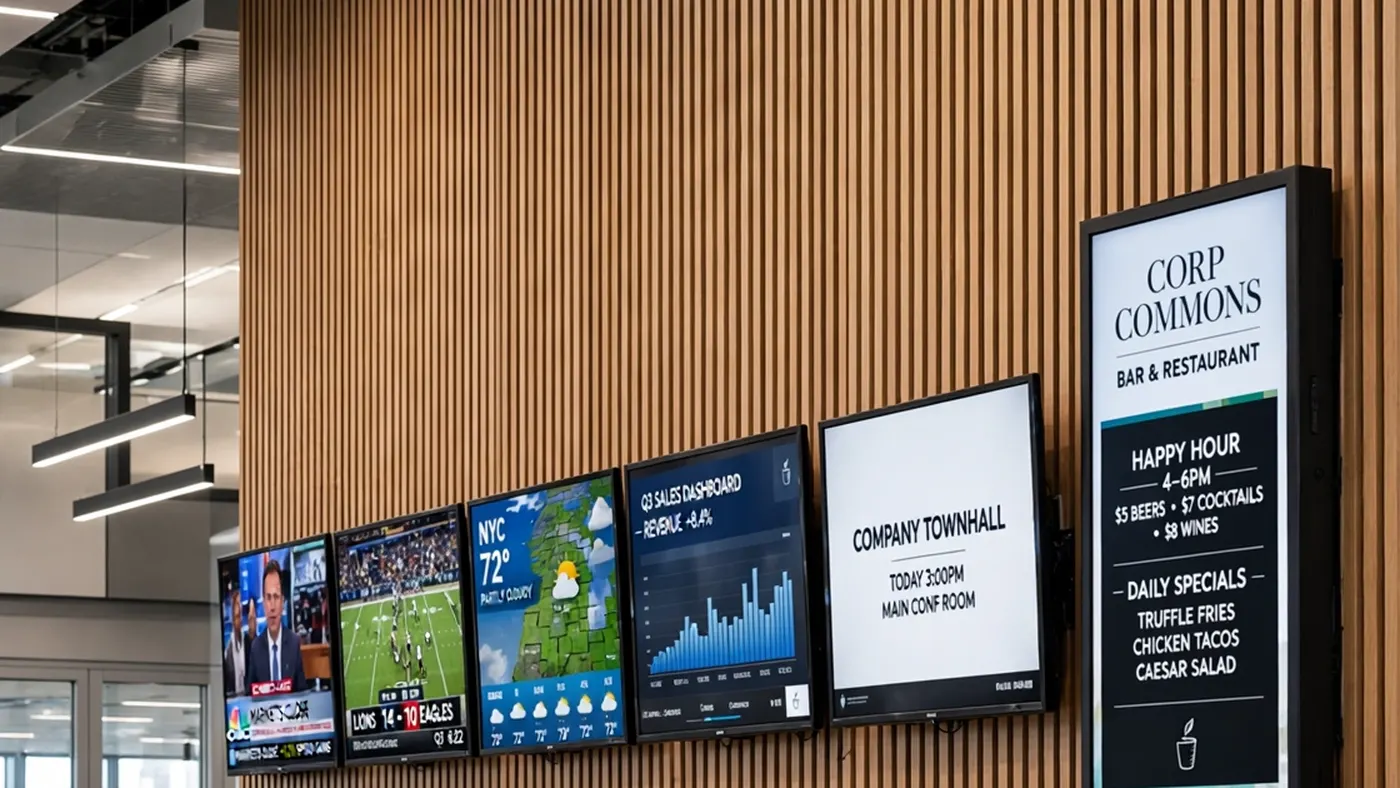
The other multi-screen arrangement is the opposite idea. Instead of one picture spread across several screens, you get several pictures at once: the main game on a large central screen, other matches, a second camera angle, a fantasy scoreboard or a race feed on the surrounding ones.
This is the setup for households where somebody follows more than one thing at a time, or where the room fills with people during a playoff run. It is also more flexible than it looks, because a wall built for several feeds can usually show one picture across the group for a film night, then go back to separate feeds on Sunday.
Arrangements vary more here than with a two-by-two block. A large main screen flanked by two smaller ones. A row of three or four equal screens. A main screen with a stack beside it. The right layout depends on where the seating is and what actually gets watched, which is worth talking through rather than copying from a photograph, because a wall that suits a bar does not automatically suit a family room.
Tiled displays, when seams are not acceptable
If the idea of visible lines through the picture bothers you, there is a category of display built specifically to avoid them. These are panels designed to sit against each other with almost nothing between them, producing one continuous image across a very large area with no interruption.
The result is spectacular and unmistakably a step above a block of ordinary televisions. It is also a significant undertaking, not something retrofitted casually into a finished room. It belongs with decisions made alongside the room itself, or as part of a renovation, and deserves a planning conversation early rather than late.
Between the two extremes sits a middle option: commercial-grade screens made for grouping, with far narrower borders than a consumer television and built to run long hours. For a games room or a home bar that is on constantly, that endurance sometimes matters more than the last millimetre of seam.
The alternative nobody mentions: one very large screen
It is worth saying plainly that a single very large panel is often the better answer, and a good installer should be willing to tell you so. Screen sizes that were exotic a few years ago are now ordinary, and one big screen gives you an uninterrupted picture, one set of settings and nothing to think about.
A single screen wins in ordinary living rooms and anywhere the wall is not large enough for a multi-screen arrangement to breathe. It loses in genuinely big rooms, in long basements, and anywhere you want the picture to cover a wall rather than sit on it. A four-screen block on a large wall does something no single television currently matches.
Projection is the third route, and in a dark room it remains strong for sheer size. It trades brightness and convenience for scale, and needs light control most living rooms cannot provide. In a finished basement with no windows, it is worth considering alongside the multi-screen approach.
Which rooms suit this
Multi-screen setups reward space, and specifically they reward depth. The further back you sit, the larger the arrangement can be before it stops feeling like a picture and starts feeling like a wall you are pressed against. These are the qualities that make the difference:
A basement is the classic candidate because it ticks several of these at once. Games rooms, home bars and dedicated theatre rooms follow for the same reasons. Main-floor living rooms can work when they are large, but they are where restraint pays off most.
- A long room lets the seating sit far enough back that a very wide picture still reads as one image.
- An uninterrupted wall matters more than total floor area, because doors, windows and returns limit the usable width.
- Ceiling height determines whether a stacked arrangement can sit at a comfortable viewing level rather than up near the joists.
- Controllable light is close to essential, since large arrangements show reflections across a much wider area.
- A room where people gather suits multiple feeds, while a room where people settle in suits one large picture.
Seating, light and the shape of the room
Seating is the part people underestimate. With a single television, a viewer off to one side loses a little picture quality. With a wide multi-screen arrangement, someone at the far end of a sectional is looking across the picture rather than at it. Plan the seating and the wall together, not one after the other. In practice that often means two rows in a long basement instead of one wide sofa.
Light is the other governing factor, and it is unforgiving at this scale. A window that puts a bright patch on one screen is a nuisance. The same window across a four-panel block is a bright patch on a quarter of your picture. Basements win here by default. Above ground, window coverings belong in the project rather than being sorted out afterwards.
Then there is proportion. A wide arrangement on a wall that is only slightly wider looks cramped. A block of screens floating in the middle of an enormous blank wall looks unfinished. The arrangement should relate to the wall it sits on and to the furniture below it, which is why we would rather look at the room than work from measurements over the phone.
Where the picture comes from
A multi-screen setup is only as good as what you feed it. Think about this early, because it shapes what the wall can do and it is the part most likely to disappoint if left as an afterthought.
For a single picture spread across several screens, the practical question is what you actually want to watch at that size. Films and live sport reward it enormously. A gaming console driving a wall that size is a particular experience, and one of the more common reasons people build these rooms. Ordinary broadcast and older content will not always look better simply for being bigger, and it is fair to expect an honest word about that rather than a promise that everything will look incredible.
For a sports wall, the question is how many separate feeds you want at once and where they come from. That shapes a good deal of the setup and is far easier to plan for at the start than to add later. Sound deserves the same early thought. A picture that size with sound coming from panel speakers is a mismatch you will notice on the first evening.
What to expect from the process
It starts with a proper look at the room. Someone should measure the wall, sit where you sit, ask what the room is really for, ask about light and who else uses it, and check what the wall and the space behind it can accommodate. Multi-screen arrangements ask more of a wall than a single television does, and that is an assessment rather than an assumption.
Expect a conversation about trade-offs rather than a sales pitch. Whether four screens or one large one suits you better. Whether seams will bother you. Whether the seating needs rethinking. Anyone who says yes to everything without seeing the space is skipping the part that decides whether you are happy with it.
Expect the result to look deliberate. A multi-screen wall planned properly reads as architecture, level and square and evenly spaced, with nothing visible that should not be. Done casually it reads as a pile of televisions. The difference is entirely in the planning and the execution. If you have an idea for a room, it costs nothing to describe it and find out what is realistic in the space you have.
Multi-screen rooms in Ottawa basements
The typical Ottawa basement is a good candidate with one caveat: ceiling height. Finished lower levels in this city often sit under ductwork and beams, which limits how tall a stacked arrangement can be before the top of the picture ends up higher than anyone wants to look. A two-by-two block needs enough height to sit at a comfortable level, and this is the first thing worth measuring in a Barrhaven or Kanata basement.
Length usually works in your favour. Ottawa rec rooms tend to run long, which gives you the viewing distance a wide arrangement needs, and it often allows two rows of seating so a crowd can watch without half of them looking across the picture. Light is rarely the problem it is elsewhere, because basement windows are small and easy to cover, which makes these rooms unusually forgiving for large-format viewing.
The walls themselves vary and need looking at. Ottawa basements combine poured concrete foundation walls, framed and finished partitions, and the occasional stone or brick feature, and what sits behind a finished surface downstairs is not always what you would expect. A multi-screen wall asks more of a wall than a single television does, so an on-site assessment matters more here than for an ordinary living room job. And if the ambition is a sports wall with several games running at once, that is a conversation to have before anything is chosen, because it shapes the whole setup.
What this costs in Ottawa
Flat pricing by screen size, taxes and the wall mount quoted before you book. No hourly rate, no surprise line items on the day.
Your exact total, tax included, takes about a minute on the price tool. A $25 deposit holds the slot and comes off the final bill.
Questions we get asked
Can four televisions really show one picture together?
Yes, and it is one of the most requested setups for basements and games rooms. The four panels behave as a single canvas, giving a picture far larger than any single television you could buy. The one thing to know in advance is that ordinary screens have slim borders, so faint lines run through the image.
Will the lines between the screens ruin it?
Most people stop noticing them within a few minutes, especially in a dark room with a large, bright picture. A minority never make peace with them. If you suspect you are in the second group, look at a purpose-built tiled display instead, which is designed to give one continuous image with effectively no interruption.
Would I be better off with one very large screen?
Often, yes, and we will say so if that is our honest read of your room. Large single panels are excellent and far simpler to live with. Multi-screen arrangements earn their place in big rooms, long basements and anywhere you want the picture to cover the wall rather than sit on it.
Can a sports wall also show one big picture for movies?
In most cases yes, and it is a sensible way to plan the room. The wall shows separate feeds when there is more than one game worth watching and switches to a single large picture for a film. Say up front that you want both, because it influences how the setup is put together.
What size room do I need?
There is no single number, because it depends on the width of your wall and how far back the seating sits. Depth matters most: you need to be far enough away for a wide picture to read as one image. A long basement usually works well, and a small living room usually does not.
Is this only for new builds or renovations?
Not at all. Multi-screen arrangements go into finished rooms regularly. Purpose-built tiled displays are the exception, since they are best planned alongside a renovation. The way to find out which category your room falls into is to have it looked at.
Will a four-screen wall fit in a standard Ottawa basement?
Often yes, and length is usually not the issue. The constraint is ceiling height, since finished basements here frequently sit under ductwork and beams, and a stacked arrangement needs enough room to sit at a comfortable viewing level. The height is the first thing to check.
Can we set up a wall for playoff nights with several games at once?
That is one of the most requested versions of this in Ottawa. Tell us at the start how many feeds you want running together and whether you also want one big picture for films, because both are achievable and it affects how the room is planned.
Ready to get it on the wall?
Answer a few questions and you will see your exact total, taxes in, before you book anything. Book now, mounted today, not next week.