Ottawa adds screens to rooms that most cities do not, and the weather is the reason. Winter here runs long enough that the finished basement becomes the second living room from October onwards, and the garage gym, the treadmill in the spare room and the office in the smallest bedroom all get used far more than they would in a milder climate. This is also a government town with an enormous number of people working from home part of the week, so the spare-bedroom office is a standard feature of houses across Nepean, Orléans and Barrhaven rather than an unusual request.
The flip side is that the outdoor season is short and intense. A covered deck in Kanata or a three-season sunroom in Stittsville is a wonderful room in July and an unheated box in February, which changes what can live out there permanently. Older houses in the Glebe, Westboro and Hintonburg add another wrinkle, with small rooms, plaster, converted attics and kitchens that were never designed to hold anything electronic. Between the deep-freeze garage, the humid basement and the sunroom that swings sixty degrees across a year, Ottawa asks more of a screen than the room it is in usually suggests.
The television has left the living room
For most of the last thirty years a house had one television, and it sat in the room with the best couch. That is no longer how people live. In a normal week we mount more screens in bedrooms, kitchens, gyms and covered outdoor spaces than in living rooms. The reason is not fashion. Panels became thin, bright and affordable enough to survive rooms that would have ruined them a decade ago.
Every one of those rooms asks a different question. The living room question is comparatively easy: where does the family sit, and how high should it go. A bedroom is watched lying down. A kitchen is watched standing up and moving around. A gym is watched from a machine or from the floor. A patio has weather. Getting any of them right has less to do with the bracket than with understanding what actually happens in the room, which is why it is worth talking through before anything is bought.
Bedrooms
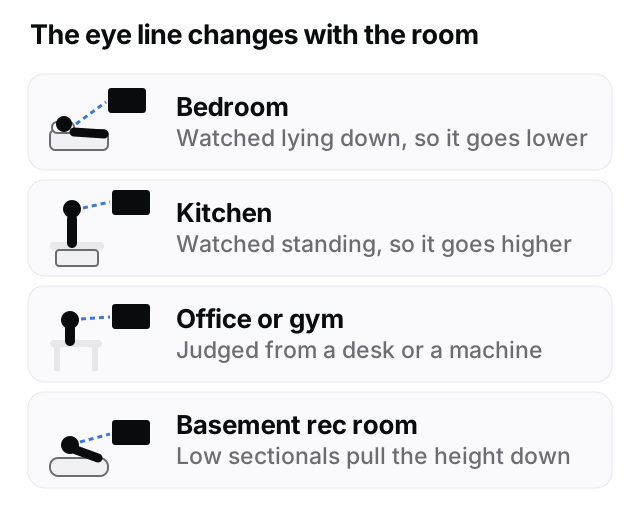
A bedroom is the only room in the house where the audience is horizontal, and that changes everything about height. In a living room the aim is a screen centred near seated eye level. Propped against pillows, your eye line is higher than you would guess and your head is already tipped back. A screen set at living-room height ends up too low, and you spend the evening looking down at it past your own feet.
This is the room where a tilting bracket genuinely earns its place. A screen a little higher, angled down towards the bed, looks natural from the pillows and stays clear of the dresser and the wardrobe doors.
Two other things are specific to bedrooms. Morning light usually lands on the wall opposite the bed, which is precisely where the television wants to go, so a room that is dark at ten at night can be unwatchable at eight in the morning. And bedroom audio has a different job than living-room audio. It has to deliver clear speech quietly, late, without carrying down the hall, which usually points to a small bar rather than anything ambitious.
Kitchens
Kitchens are the room people are most surprised we do, and they are one of the most used screens in the house. The kitchen screen is not the main event. It is news in the morning, a game on while somebody cooks, a video call propped up while hands are busy.
That changes the brief completely. Size comes down, because a screen that is too large dominates a room people are trying to work in. Position goes up, often into a corner or above a run of cabinets, because the sightline that matters is from the sink and the island rather than from a chair. Angle matters more here than anywhere else in the house, since the viewer moves between three or four standing positions instead of settling into one.
Kitchens also produce heat, steam and airborne grease. A screen directly above a range takes all three and will not last. The same screen across the room, out of the plume, is entirely fine. Cabinet runs, tiled backsplashes and the wall over a fridge each behave differently and each need looking at rather than assuming. Power is the thing most often forgotten in a kitchen, because there is rarely an outlet where the screen wants to be.
Home offices
Working from home turned a lot of spare bedrooms into offices, and a mounted screen in one does two jobs. It is a second display through the day and a television in the evening.
The tension is eye height. A television watched from a couch wants to sit low. A display you work at for eight hours wants its top edge near eye level so your neck stays neutral. If the room is genuinely a working office, prioritise the working position and accept that evening viewing is the compromise, rather than the other way round. Your neck will notice the difference; your evenings will not.
Then there is what the camera sees. Video calls have made the wall behind you part of your professional appearance, and a screen mounted where daylight falls straight across it will look washed out for most of the working day. Turning the desk so you are not backlit, and putting the screen on a wall the window does not attack, solves most of it. It is worth deciding which wall is the call wall before deciding which wall is the screen wall.
Home gyms
Garage and basement gyms are one of the fastest-growing reasons people call us, and they break the usual rules cheerfully.
Start with where you look from. On a treadmill or a bike you are standing, raised up and looking straight ahead, so the screen goes considerably higher than any living-room screen would. On a mat doing floor work you are looking up from below. In a room that does both, one activity wins and the other tolerates, so decide which one actually happens most often before anyone chooses a height.
Then protect the screen. A gym has weight moving around inside it, and a panel on a low fixed bracket in the path of a bar is a mistake you only make once. Higher, and out of the traffic, is nearly always the answer. Sweat, chalk dust and large temperature swings are all real in a garage, and a screen that lives in an unheated space through a Canadian winter is being asked to do something it was never designed for.
Sound in a gym competes with a fan, a treadmill and your own breathing. It is one of the few rooms where audio is harder to solve than picture.
Basements and rec rooms
Basements are where the biggest screen in the house usually ends up, and for good reasons. There is no daylight to fight, the room is often the longest in the house, and nobody minds if it is dark.
The constraints are structural, and they are worth knowing before you fall in love with a particular wall. Ceilings are lower, and a duct, beam or bulkhead frequently runs exactly where you wanted the screen to be. At least one wall is likely to be concrete or block with a framed wall built in front of it, which is not a reason to avoid it but is a reason to have someone look before anything is ordered. Sightlines along a long room with a sectional are unforgiving, and the wall that looks obvious is often not the wall that works.
Basements also run humid in summer and cold in winter if the finishing was done cheaply. Electronics cope with that better than people expect, but a basement that has ever taken on water changes where equipment should sit.
Outdoor and covered spaces
This is the thing people most often do not realise is possible. Outdoor televisions are a real and mature category, and they are not indoor sets with a cover thrown over them.
There are broadly three tiers. Full-sun models are dramatically brighter than anything sold for indoors and are built to sit in direct sunlight, which would otherwise overheat an ordinary panel and damage it permanently. Partial-sun models suit a space that catches light for part of the day. Full-shade models are made for roofed, covered areas and are the most common thing we install outdoors. All three are sealed against moisture and insects and rated for temperature ranges that would end an indoor television quickly.
Putting an ordinary indoor set under a roof is the single most common outdoor mistake. It usually survives the first summer. Then condensation, cold nights and insects finish it, faster here than in a milder climate.
Decide early how much direct sun the spot takes and at what hour, whether the screen stays out year-round or comes in, what the mounting surface actually is, where power will come from, and how sound will work in a space with no walls to hold it. Outdoor screens also earn their keep on sport and background viewing far more than on films.
Bathrooms, garages, workshops and the rest
Bathrooms surprise people, and they are entirely achievable with the right product. Moisture-rated and waterproof televisions exist, including mirrored models that look like a mirror when off and show a picture when on. They are a genuine luxury item, and they only work as the purpose-built product. An ordinary set in a steamy room fails.
Garages and workshops want durability rather than beauty. Dust, cold, vibration and the occasional impact are the enemies, so high on a wall and well clear of both the door track and the working area is almost always right.
Several others come up regularly. Dining rooms, where a screen that disappears when off matters more than size. Laundry and craft rooms, where a small screen makes a chore tolerable. Nurseries and playrooms, where getting it out of reach is the entire brief. Sunrooms and three-season rooms, which behave like outdoor spaces even though they feel like indoor ones. Cottage bunkies.
The honest summary is that almost any room can take a screen. The real question is whether the room deserves one, and what the room will do to it once it is there.
How to decide whether a room earns a screen
Before adding a television to a room, it is worth answering a short set of questions honestly. Nearly every regret we hear about traces back to skipping one of them.
- Ask who watches from where, and whether they will be sitting, standing, lying down or moving around.
- Ask what the light does in that room across a whole day, not just at the moment you happen to be standing in it.
- Ask what the room does to electronics, whether that is steam, grease, sweat, dust, cold or damp.
- Ask where power is, because that is the constraint that most often decides the wall for you.
- Ask what the sound has to compete with, from a range hood to a treadmill to rain on a patio roof.
- Ask whether the screen has to look good when it is switched off, which matters far more in a bedroom or dining room than in a workshop.
The rooms Ottawa actually asks about
The finished basement is the most common second screen in this city, and it is the easiest of the group. No daylight, a long room, and a family that will use it every night from November to April. The things to check first are the bulkheads and ducts crossing the ceiling, the concrete or block wall behind the framing on at least one side, and whether the room has ever been damp in a wet spring.
Garage gyms are the request that needs the most honest conversation. An attached Kanata or Barrhaven garage can sit near freezing for weeks, and most indoor panels are not rated for that. If the space is heated while you use it and stays above freezing otherwise, an ordinary screen is usually fine. If it genuinely goes cold and stays cold, the sensible answer is either bringing the screen indoors for the season or buying one built for the temperature range.
Three-season sunrooms deserve the same treatment. They feel like an indoor room and behave like an outdoor one, with condensation forming on cold mornings and heat building on sunny afternoons.
Home offices are the quiet growth area. With a large share of the public service working part of the week from home, the second bedroom in an Orléans or Riverside South build has become a working room with a screen doing double duty, and getting the height right for a working day matters more than getting it right for a film.
What this costs in Ottawa
Flat pricing by screen size, taxes and the wall mount quoted before you book. No hourly rate, no surprise line items on the day.
Your exact total, tax included, takes about a minute on the price tool. A $25 deposit holds the slot and comes off the final bill.
Questions we get asked
Can a normal television go on a covered porch if it never gets rained on?
It is the most common outdoor mistake we are called back to fix. A roof stops rain but not humidity, condensation, cold nights or insects, all of which get inside an indoor set that is not sealed. Outdoor-rated models exist in shade, partial-sun and full-sun versions and are built for exactly that job.
Should a bedroom television go higher than a living room one?
Usually yes, and it should be angled down. You watch a bedroom screen from a reclined position with your head tipped back, so a screen set at living-room height feels low and awkward from the pillows. Height and tilt are decided together, based on where the head of the bed actually sits.
Is a kitchen screen worth it, or is it a novelty?
In our experience it is one of the most used screens in a house, but only if it is sized and placed for standing viewing. Keep it modest in size, put it where you can see it from the sink and the island, and keep it well away from the heat and steam above a range.
Can a television survive an unheated garage over winter?
Most indoor panels are rated for a narrower temperature range than an unheated Canadian garage sees, and repeated freezing and thawing brings condensation with it. If the space is heated when in use and never drops far below freezing, an indoor set can work. If it genuinely goes cold, the right answer is a screen built for the conditions.
Are bathroom televisions actually a real thing?
Yes, and they have improved a lot. Purpose-built waterproof models handle steam and splashing, and mirrored versions sit flush and look like a mirror until they are switched on. The important part is buying the right product for the environment rather than adapting an ordinary television.
Can we put a screen in the three-season sunroom?
Yes, but treat that room as outdoor space rather than indoor space. Ottawa sunrooms swing from below freezing to very warm across a year and they collect condensation on cold mornings, which is what damages an ordinary panel. A shade-rated outdoor model handles it, or an indoor screen can live there seasonally and come inside for winter.
Is the basement or the main floor the better place for the big screen?
In most Ottawa houses the basement wins on picture quality alone, because there is no daylight to fight and you can watch comfortably at any hour. The main floor great room in the newer Barrhaven and Stittsville builds is brighter and more open, which usually means a brighter screen and more thought about the windows.
Ready to get it on the wall?
Answer a few questions and you will see your exact total, taxes in, before you book anything. Book now, mounted today, not next week.