Ottawa gives you two completely different sizing problems in the same house. Upstairs, the newer builds in Barrhaven, Kanata and Riverside South have great rooms open to the kitchen, high ceilings and a fireplace centred on the feature wall, which pushes the screen up and makes the size and height questions inseparable. Downstairs, the finished basement rec room has a lower ceiling, a long sightline and no natural light to fight, which is a very forgiving environment for a large panel.
The winters make that basement matter. From November to March a great many Ottawa households effectively live down there, and the rec room takes far more screen time than the formal living room ever does. That is worth remembering when you are deciding where the money goes. Then there is the older stock. Bungalows in Nepean, Alta Vista and Elmvale Acres, and the brick homes in Westboro and the Glebe, have smaller living rooms with narrower walls, radiators, window casings and original trim, and those rooms set real limits. And because so much of this city works from home, the spare bedroom or basement office often needs a screen sized for a desk rather than a sofa.
Why the showroom lies to you
A retail floor is a very large room with very high ceilings, lit evenly and packed with screens standing side by side. Every television in it looks smaller than it is, because there is nothing human-scaled nearby to measure it against and because the set next to it is probably bigger. People walk out having bought the size that looked reasonable in a warehouse and then live with it in a room with a nine-foot ceiling and a sofa three and a half metres away.
The reverse mistake happens online, where a screen is a number and a number is abstract. Seventy-five inches sounds like a lot until it is on your wall, at which point it can look either commanding or comical depending on details nobody mentioned on the product page.
The fix is not a formula. It is a short sequence of checks you can do in your own room in about twenty minutes, and every one of them is more reliable than a first impression in a store.
Start with where you actually sit
Seating distance is the first constraint and the one most people skip. Measure from the back of the seat cushion you actually use to the wall the television will be on. Not the middle of the room, not the closest chair, the seat where the person who watches most sits every evening.
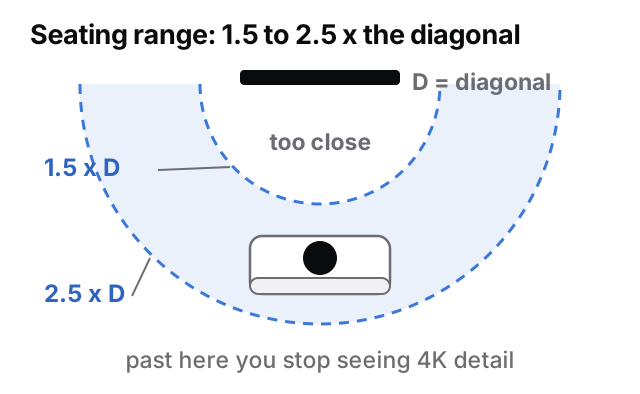
For a 4K screen, a commonly used guide is to sit somewhere between about one and a half and two and a half times the screen's diagonal away from it. That is a range rather than a rule, and where you land inside it is a matter of taste. Closer gives you the immersive, cinema-adjacent experience that gamers and film watchers tend to prefer. Further back is more relaxed and better suited to a room where the television is background as often as it is the main event.
Two practical notes. Multiply the diagonal by roughly two and a half and you have a sensible upper bound on comfortable distance; anything further and you start losing the detail you paid for. And remember that a mounted television usually sits slightly further from the seating than the same set on a stand did, because the wall is behind the cabinet rather than in front of it.
Then measure the wall, not the television
A screen needs breathing room. A seventy-five inch panel is roughly a hundred and sixty-five centimetres wide, and if the wall it is going on is only two metres across between a window casing and a doorway, the result reads as crowded no matter how good the picture is. The eye wants some wall left over on each side, and a screen that runs nearly the full width of its wall looks like it was installed under duress.
Look at what interrupts the wall as well as how wide it is. Window trim, a doorway, a fireplace surround, a return corner, a light switch, a thermostat, a heat register. Any of those can decide the size for you, and it is far better to find out now than on install day.
The wall also has to be able to carry what you choose, and how it does that depends on what it is built from. That part is our job rather than yours, but it is worth mentioning your intended size early in the conversation, because on some walls it genuinely changes what is possible.
What sits below the screen changes everything
Almost nobody mounts a television over an empty wall. There is a console, a credenza, a fireplace, a radiator or a sideboard underneath, and the relationship between that piece of furniture and the screen is what the room actually reads.
The general instinct that works is for the television to be narrower than the furniture beneath it, or at most about the same width. A screen wider than its console looks top-heavy and slightly precarious even when it is perfectly secure. If your credenza is a metre and a half wide and you are considering a screen that is a metre and three-quarters, the honest options are a smaller screen, a wider console, or accepting a look that will nag at you.
A soundbar changes the arithmetic too. It needs somewhere to sit or hang without cutting into the bottom of the picture or blocking the screen's own sensor, and that space has to come from somewhere. Decide where the audio is going before you fix the screen size, not after.
Light, windows and where the glare lands
Screen size and room light interact more than people expect. A larger panel is a larger reflective surface, so in a bright room with windows facing or flanking the television, going up a size can mean going up in glare as well.
Sit in your seat during the daytime and look at the blank wall. Note where the windows would fall in the reflection, and note whether there is a light fixture or a glass door behind you. If the answer is that half the wall catches the afternoon sun, the size question becomes partly a finish and placement question, and a slightly smaller screen on a better wall will beat a larger one facing a window.
Evening viewing has the opposite bias. In a dark room a large bright screen is far more fatiguing than the same screen in a lit one, which is one reason a little ambient light behind the television makes big panels more comfortable to live with.
Resolution, content and how close you can get
Modern 4K panels are detailed enough that at normal living-room distances you will not see pixel structure, which is why screens have been able to grow so much in the last decade. That is the good news, and it means size is now limited by the room rather than by the technology.
What has not changed is that a big screen is honest about its source. Sharp 4K streaming, discs and modern console games look superb. Older standard-definition broadcast, heavily compressed streams and some cable channels look noticeably softer at seventy-five inches than they did at fifty. If a large share of your viewing is basic cable news or an old library of low-resolution content, temper the size upgrade accordingly.
8K is not a reason to size up. There is very little content and the practical benefit at real seating distances is slight. Buy the size the room wants and spend the difference on panel quality, because contrast and brightness will improve your evenings far more than a resolution you cannot resolve from the sofa.
The too-big failure mode is real but rare
Oversizing does happen, and it has a recognisable shape. The screen fills the wall edge to edge with no margin. The seating is close enough that you find yourself moving your eyes across the picture rather than taking it in whole, which is tiring over a two-hour film. Or the size forced the mount higher than it should be to clear the furniture, and now you are looking up all evening.
There is a logistical version too. Very large panels are awkward to bring up a narrow stairwell, around a tight landing, or into a unit with a small elevator, and delivery is a separate problem from installation. It is worth thinking about the route into the room before you order, particularly in older houses and older buildings.
Note what is not on that list: nobody has ever regretted a large television because the picture was too immersive. The failures are about geometry and logistics, and both are avoidable at the planning stage.
The far more common regret is going too small
In our experience the overwhelming majority of people who are unhappy with their screen size wish they had gone bigger. It shows up a few weeks in, once the initial shock of a new object on the wall has worn off and the room has absorbed it. What felt enormous in the box looks entirely normal by the second weekend.
The reason is straightforward. You adapt to size in days and you live with the limitation for years. A screen that is one step too small never becomes a problem you can point at, it just quietly under-delivers every evening, particularly for sport and for anything with subtitles.
There is also a false economy at work. The gap in price between one size and the next is usually far smaller than the gap between two panel tiers, and the size difference is the one you will notice from the sofa. If you are genuinely torn between two adjacent sizes and the wall and the furniture can both accommodate the larger one, take the larger one.
Sanity-check the size before you buy
None of this requires guesswork. Twenty minutes of checking in the actual room will settle it, and it costs nothing to be wrong on paper.
Be honest at this stage about where people actually sit rather than where the furniture is supposed to go, and ask what the room looks like when the television is off. A very large panel is a very large dark surface for most of the day, and in a small room that has consequences for how the space feels. It rarely means going smaller. It usually means choosing a height and a finish that make the off-state easier to live with. With that settled, work through the following before you order.
- Find the width and height of the screen itself in the specifications rather than working from the diagonal, because two sets of the same nominal size can differ in bezel and proportion.
- Mark those dimensions on the wall with low-tack painter's tape or a cut sheet of cardboard, then leave it there for a day and walk past it a few times.
- Sit in your usual seat and look at the outline in daylight and again in the evening, because the two impressions are often different.
- Check the outline against the furniture below it, the window trim beside it and any doorway that will share the wall.
- Confirm the route into the room, including stairwells, landings, doorways and elevators, before the delivery is booked.
- Tell your installer the size you are considering while the wall is still being assessed, so any constraint comes up before the purchase rather than after.
Sizing for an Ottawa great room and an Ottawa basement
In the west-end great rooms the constraint is almost never the wall width. Those feature walls are generous and they will happily take a large panel. The constraint is the fireplace, because the surround and the mantel set a floor for how low the screen can sit, and a bigger screen in that position starts higher and finishes higher still. If your sofa is nine feet back and the screen has to clear a mantel, the size that works on the wall may not be the size that works for your neck. It is worth considering whether an adjacent wall gives you a lower, closer, more comfortable result before defaulting to the fireplace.
Basements invert almost every one of these variables. Ceilings are lower, which caps how high the screen can go, but seating distance is often longer because rec rooms are laid out along the length of the house. There is usually little or no daylight, which removes the glare question entirely, and the walls are frequently against poured concrete foundation or framed out in front of it, which affects what is possible in ways that need to be looked at rather than guessed.
The practical Ottawa answer is that basements tolerate larger screens than people assume and great rooms tolerate them at a lower height than people assume. If you only have the budget to do one room properly this year, do the one your family actually uses in February.
One more local note: a lot of Ottawa homes have a narrow, turned basement stairwell. Measure the route down before you order a very large panel.
What this costs in Ottawa
Flat pricing by screen size, taxes and the wall mount quoted before you book. No hourly rate, no surprise line items on the day.
Your exact total, tax included, takes about a minute on the price tool. A $25 deposit holds the slot and comes off the final bill.
Questions we get asked
Does mounting a television change what size I should buy?
Slightly, and usually in favour of a larger one. A mounted screen sits against the wall rather than on a cabinet in front of it, which typically adds a little seating distance and frees up the surface below. It also removes the constraint of the stand's footprint, so a screen that would not have fitted the console can still fit the wall.
Is there such a thing as too big for a living room?
Yes, but it is less common than people fear. The real limits are the width of the wall it has to live on, the width of the furniture beneath it, and whether the size forces the screen higher than is comfortable. If those three are satisfied, larger is almost always the better call.
How much of a jump should I make from my current television?
Most people who move up one size wish they had moved up two. If your room and wall support it, going two steps up from an older screen tends to feel right rather than excessive, because panels have grown thinner and the bezels have shrunk considerably since the last purchase.
Does a bigger screen need a different kind of mount?
Sometimes. Size, weight and how far you want the screen to move all influence what gets specified, and larger panels put more demand on both the bracket and the wall. That assessment happens on site, which is why it helps to mention the size you are considering when you first get in touch.
Should I buy 8K to future-proof?
There is very little 8K content and at normal seating distances the difference is hard to see. The money is better spent on screen size, contrast and brightness, all of which you will notice every evening on the content that actually exists today.
The room is small. Am I stuck with a small television?
Rarely. Small rooms limit wall width and seating distance more than they limit screen size, and a well-placed screen at a sensible height often works better in a compact room than people expect. The tape outline test is especially worth doing in a small room, because the answer is frequently more generous than the instinct.
Our great room has a fireplace on the feature wall. Does that limit the size?
It limits the height more than the width, and the two are connected. A larger screen above a mantel sits higher overall, which can push it past a comfortable viewing line from a sofa eight or nine feet away. If the room offers a second workable wall, it is worth comparing both before choosing the size.
How big can we go in a finished Ottawa basement?
Usually bigger than expected. Basement rec rooms tend to have longer sightlines and no daylight to fight, which is the ideal combination for a large panel. The real limits are the ceiling height, which caps how high it can sit, and the stairwell you have to carry it down.
Ready to get it on the wall?
Answer a few questions and you will see your exact total, taxes in, before you book anything. Book now, mounted today, not next week.