Ottawa's commercial screen work splits along lines that would not exist in another city. On one side is a government and technology town: boardrooms on Slater and Albert, meeting rooms in the Kanata tech campuses along March Road, huddle rooms in converted Centretown offices. All of them need screens that behave predictably in a meeting and connect without ceremony in front of a visitor.
On the other side is a hospitality and community town built around the winter. Pubs on Elgin Street and in the ByWard Market fill up on Senators nights and every seat expects to see the game. Gyms in Barrhaven, Kanata and Orleans run from before dawn. Community halls, legions, arenas and churches across the region host everything from minor hockey banquets to Sunday services in rooms with high ceilings and stone walls. Clinics and dental practices in every suburb have waiting rooms that need a screen doing something calm. Add Gatineau across the river and a genuinely bilingual working environment, and the brief for an Ottawa business is often more varied than the size of the city suggests.
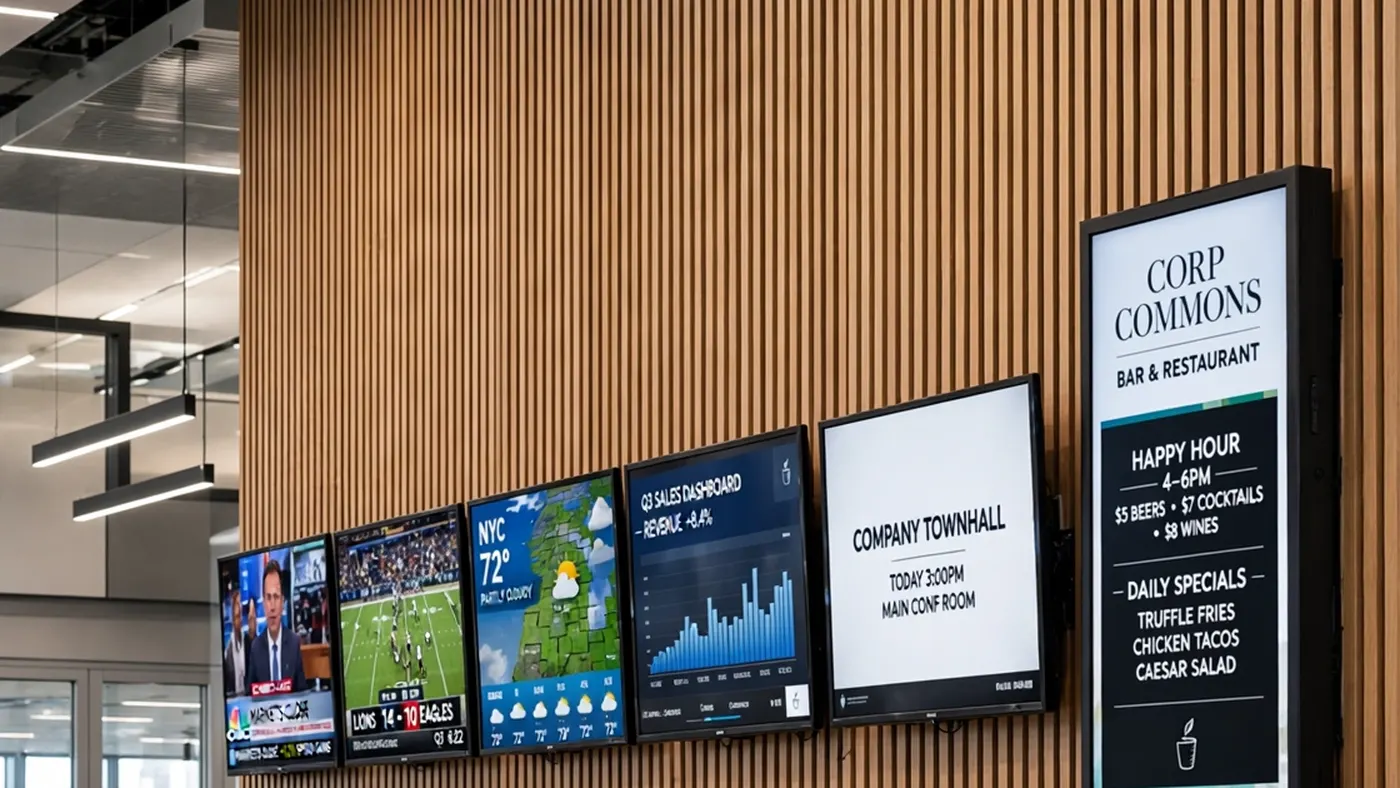
A business screen is equipment, not furniture
A television in a house gets watched in the evening. A screen in a business runs for ten, twelve, sometimes eighteen hours a day, in front of people who did not choose it, in a room where nobody is going to be gentle with it. That difference drives almost every decision that follows.
Commercial work is judged on different things. It has to survive being knocked. It has to sit out of reach of hands that will touch it. It has to keep working when nobody in the building knows anything about it. And it has to look deliberate rather than improvised, because a crooked screen with a visible cable in a customer-facing room says something about the business that the business did not intend to say.
It also has to fit a schedule that belongs to someone else. A home install happens whenever the family is around. A restaurant install happens between the end of one service and the start of the next. Getting that right is as much a part of the job as the wall.
Restaurants, bars and pubs
Sightlines are everything. The question is not where a screen fits, it is which seats can see it, and in a room with booths, a bar rail, columns and a low ceiling those two answers are rarely the same. The usual outcome is more screens than the owner first imagined, each smaller than expected, angled so the room works from every seat rather than from the middle of the floor.
Height and reach matter more here than anywhere. Screens go high enough that nobody catches a shoulder on them and nobody can reach the buttons or the cables, which means the mounts have to hold their angle firmly and the wiring has to be out of sight and out of hands. Kitchens, passes and patio doors add heat, grease and moisture, and a screen near any of them needs to be specified for it.
Sound is the other half. Most hospitality rooms run screens muted with the house audio doing the work, so what you need is a picture that reads from across the room and a system where one person behind the bar can change every screen without a drawer full of remotes.
Gyms and fitness studios
Gyms are the harshest rooms we install into. Screens sit high, run all day, and live in a space full of moving metal, chalk dust and vibration. The mount has to be genuinely secure above equipment people are lifting under, and it has to stay exactly where it was set, because nobody notices a slow drift until a member does.
Placement follows the equipment. A cardio wall wants screens at the eye line of someone on a treadmill, which is higher than a seated eye line and lower than a bar screen. A studio wants a screen visible from the floor with the instructor not blocking it. A functional training area wants screens well clear of anything that swings.
Cable management here is a safety matter rather than an aesthetic one. Nothing reachable, nothing loose, and everything serviceable without closing the floor.
Offices, boardrooms and meeting spaces
Boardroom screens fail for boring reasons. They are mounted too high, so everyone at the table looks up all meeting. They are too small for the far end of the table, so half the room squints at a spreadsheet. Or the connection is a cable somebody has to crawl under the table to find, which quietly costs the company five minutes at the start of every meeting for years.
The fix is planning that starts with the table, not the wall. Screen size follows the distance to the furthest seat. Height follows seated eye level. The connection point belongs where people actually sit, and the equipment should be concealed but reachable for whoever supports it.
Newer offices are frequently built with steel-framed partitions rather than wood, and with glass walls that cannot take a screen at all, so the wall you were planning on may not be the wall you end up using. Establish that before the furniture is ordered. Huddle rooms have the same problems in miniature and usually want a smaller screen closer than instinct suggests.
Retail and digital signage
A signage screen is a sales tool that happens to be a display, and the mistakes are usually about content rather than hardware. A screen in the wrong orientation, running a loop nobody updates, or sitting where window light washes it out, is worse than no screen at all.
Decide these before anything goes on a wall. Portrait or landscape, and consistently across the store. How content gets onto the screen and who changes it. Whether screens should power on and off with trading hours by themselves rather than by somebody remembering. And whether a screen needs to be bright enough for a window position, which is a different class of display from the one in the stockroom corridor.
Placement is a merchandising decision. A screen above a till is seen by people already buying. A screen at the entrance is seen by people deciding. Multi-screen runs along a wall or above a counter have to line up precisely, because the eye reads a row of screens as a single object and one that is slightly out looks careless.
Waiting rooms, hotels, schools and halls
Clinics and waiting rooms want the opposite of a sports bar. The screen should be quiet, low in glare, easy on people who are anxious, and completely out of reach of children. Volume control a receptionist can reach and a patient cannot is worth asking for.
Hotels have volume in the other sense: many rooms, identical installs, and a standard that has to hold across all of them. Consistency, tamper resistance and a mounting choice that survives housekeeping and guests are what matter. Lobbies and meeting rooms are their own specification.
Schools need screens that live alongside children, which means height, security fixings and cable routes nobody can get a hand into. Gymnasiums and multipurpose rooms add ball impact to the list.
Churches and community halls are often the most interesting rooms we work in. High ceilings, long sightlines, stone or masonry walls, heritage surfaces that must not be marked, and a requirement that everything looks like it belongs. The answer is usually fewer and larger screens placed where the architecture allows, and sometimes ceiling or pole mounting rather than a wall at all.
Working around a business that has to stay open
Almost every commercial job is really a scheduling job. Restaurants get installed between services or before opening. Gyms get done mid-morning or after close. Offices prefer an evening or a weekend so nobody loses a working day. Retail wants it before doors open. Clinics want it when the waiting room is empty.
What makes that work is agreeing the window in advance and being honest about what fits inside it. A single screen in a prepared room is a short visit. A six-screen bar with concealed cabling and a new power position is not a job to start ninety minutes before a Friday service. If a job will not finish in one window, it is far better to split it deliberately across two.
Tell your installer your busiest hours, your quietest hours, your delivery access, and who will be on site with a key. Those four facts remove most of the risk from a commercial booking.
Security, service and warranty
Commercial screens are worth stealing and easy to damage, and they are also expected to keep working without anyone thinking about them. Both are handled at install time rather than afterwards.
Manufacturer warranties on commercial displays and on consumer televisions are not the same thing, and a consumer set used in a business may not be covered for the hours you intend to run it. That is a purchasing question worth asking before the screens arrive, not after one fails in its second year.
- Public-facing screens should be mounted so they cannot simply be lifted away, and in higher-risk rooms that means security-fixed hardware rather than a standard bracket.
- Cables and source equipment should be concealed and inaccessible, both for tidiness and so nobody unplugs something to charge a phone.
- Every screen should be reachable for service without dismantling the room or closing the floor.
- Someone on your staff should know how the system is switched on, switched off and reset, and that should be written down rather than remembered.
- Ask what workmanship warranty applies, what happens if a mount needs attention, and who to call.
What to put in your request for a quote
A commercial quote is only as good as the brief. The more of this you can answer up front, the closer a first figure will be to the final one.
Anyone quoting a multi-screen commercial job should want to see the room, in person or at least in photographs, before committing. A quote given without that is a guess, and guesses on commercial work tend to be corrected in the wrong direction.
- How many screens, what sizes, and whether you own them already or need them supplied.
- What each wall is made of as best you know, and whether any are masonry, glass or steel-framed partition.
- Whether the screens are showing live television, a signage system, or connecting to laptops in a meeting room.
- Your opening hours and the window in which work can happen.
- Whether cables must be fully concealed, and whether new power or data positions are likely to be needed.
- Who the on-site contact is and how access to the space works.
Commercial screens in an Ottawa room
Two patterns come up constantly here. The first is the government or tech boardroom, where the requirement is not spectacle but reliability: a screen the far end of the table can read, a connection that works for a visitor's laptop without a hunt for an adapter, and an installation clean enough for a room where departments and clients get hosted. Many downtown and Kanata offices are fitted out with steel-framed partitions and glass, so the wall you planned on may not be available, and that is much cheaper to discover at the drawings stage than on installation day.
The second is the sports room. An Ottawa pub on a Senators night is the toughest sightline problem in the city, because the room fills, people stand, and every angle has to work. That normally means several screens rather than one large one, mounted high, angled deliberately, and switchable from behind the bar by whoever is working.
Winter shapes scheduling more than people expect. Deliveries, loading and access are all slower between December and March, and gyms and community centres are at their busiest in exactly that stretch. Booking commercial work for shoulder hours, with a little extra built into the window, is the difference between finishing on time and finishing in front of customers.
Community halls, legions and churches across the region often have masonry or heritage surfaces, which is careful work and worth surveying before anything is promised.
What this costs in Ottawa
Flat pricing by screen size, taxes and the wall mount quoted before you book. No hourly rate, no surprise line items on the day.
Your exact total, tax included, takes about a minute on the price tool. A $25 deposit holds the slot and comes off the final bill.
Questions we get asked
Can we use ordinary televisions, or do we need commercial displays?
It depends on how many hours a day they run and how visible they are. Consumer sets are fine in a back office or a small waiting room. For long daily hours, bright rooms, portrait signage or anything customer-facing, a commercial display is built for the duty and usually carries a warranty that reflects it.
Do you install outside our opening hours?
Yes, and for most businesses that is the default. Early mornings, evenings, quiet weekdays and closed days all work. Tell us your busiest periods when you enquire and we will schedule around them rather than into them.
How many screens does a bar or restaurant actually need?
Fewer than owners fear and more than they first plan. The right number comes from walking the room and checking what each seating group can see. It is usually better to have several well-placed screens serving every seat than one large screen serving the middle of the floor.
Can screens go on concrete, brick or block walls in a commercial space?
Yes, and that is normal work in commercial buildings. It takes longer than drywall and needs different hardware, so it should be identified before quoting. Where a wall cannot be used at all, ceiling mounts, structural supports and freestanding positions are the usual alternatives.
Do you supply the screens or do we?
Either. Many businesses buy their own displays and we install them, and we are happy to advise on what suits the room before you order. If you would rather we handled supply and installation together, we can quote it that way.
What happens if something needs attention later?
You call us and we come back. We warrant our workmanship, we install so that screens can be serviced without shutting your floor, and we leave you with a simple record of what is installed and how it is switched on. Businesses should not have to reverse-engineer their own AV.
Can you work around a Senators game night?
Yes, and that is usually the point. Most hospitality work here happens in the morning or on a quiet weekday so the room is finished long before the crowd arrives. Send us your event calendar and we will book around it rather than into it.
We are a bilingual office. Can meeting rooms and signage be set up for both languages?
Yes. Meeting room systems and signage can be configured to present in English and French, and we will make sure the on-screen setup and the written handover suit a bilingual workplace.
Ready to get it on the wall?
Answer a few questions and you will see your exact total, taxes in, before you book anything. Book now, mounted today, not next week.