Ottawa has a signature mistake, and it is the great room. The newer builds across Barrhaven, Stittsville, Riverside South and west Kanata have a two-storey main living space with a stone or tile fireplace on the feature wall, a bank of tall windows beside it and an open sightline to the kitchen. The fireplace wall looks like the only place a television can go, so up it goes, well above the mantel, and the family spends the next five winters watching it with their chins raised.
The second Ottawa pattern happens one floor down. Finished basements here are serious rooms, used from October through April, and they come with poured concrete on the exterior walls, framed walls in front of them, and ducts and bulkheads crossing the ceiling exactly where you wanted the screen. People buy a bracket for a normal drywall room and discover the room is not that. Older neighbourhoods add a third variation, with the plaster and lath in the Glebe, Westboro and Old Ottawa South behaving differently again. Almost none of this is difficult to work with. It is only difficult to work with after something has already been bought.
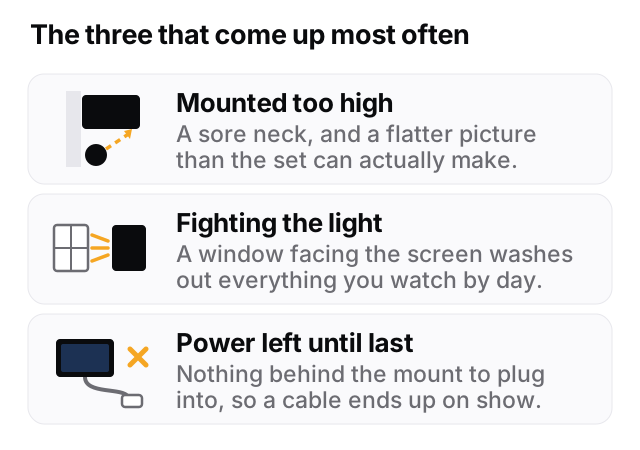
These are decisions, not skills
Nearly everything that goes wrong with a wall-mounted television goes wrong before anyone touches the wall. That is the useful thing to understand about this list. These are not skills somebody failed to acquire. They are decisions that got made quickly, or by default, or by whoever happened to be standing in the shop that afternoon.
We see the results constantly. A television that is beautiful and unwatchable. A wall that has been opened twice. A room the family quietly stopped using. In most of those cases the work itself was fine, and planning was the part that was skipped.
None of what follows takes expertise to avoid. It takes ten honest minutes thinking about the room you actually have and the way your household actually watches. Read it as a list of questions to answer, not techniques to learn.
Buying the mount before anyone has looked at the wall
The most common mistake in this trade is buying the bracket first. The television arrives, there is a wall of brackets in the shop, one says it fits your size, and it costs less than dinner.
What the box cannot tell you is what your wall is. A television that is straightforward on a standard framed wall is a different job on brick, on block, on a stone fireplace surround, on plaster over lath, on a concrete wall in a tower, or on a wall with services running inside it. The mount that suits one of those is frequently wrong for the others, and that is not something anyone can judge from the outside of the wall.
There is a second version of the same error, which is buying a mount that fits the television but not the room. A fixed flat bracket on a wall that is viewed from an angle, or a long articulating arm in an alcove that will never let it extend, are both technically correct and practically useless.
The fix is unglamorous. Describe the wall before you buy anything, or have someone look at it first.
Mounting it too high
This is the mistake people regret longest, because unlike a wrong bracket it never announces itself. It simply makes the room slightly unpleasant, permanently.
Almost every television we are called back to move is moved down. The instinct to go high comes from reasonable places. The old set sat on a tall stand, the fireplace is on that wall, and the room looks tidier with the screen up out of the furniture. But people watch television sitting down, with their eyes at a fixed height, and a screen above that height means holding your head back for two hours at a time.
Very few people identify the cause. They just watch less, or find the room tiring.
Above a fireplace is where this happens most, and it is worth saying plainly that it is sometimes the right answer and often is not. A mantel, a chimney breast and a firebox all push a screen higher than a comfortable viewing height, and the gap between a room that works and one that does not can be surprisingly small. There are ways to make a high screen tolerable and a good installer will offer them. The better move is to decide height by sitting in the seat you actually use and looking at the wall, before anything is fixed to it.
Ignoring where the light comes from
A room is a different room at three in the afternoon than it is at nine at night, and most people choose their television wall in the evening or from a floor plan.
Two things go wrong. The first is a window opposite the screen, which parks a reflection of the sky in the middle of the picture for half the day. The second, and the one people underestimate, is direct sunlight landing on the panel itself. That washes the image out while it is there and, over years, is genuinely hard on a screen.
The failure is quiet. Nobody says the television is in the wrong place. They say daytime viewing is not great, and pull the blinds every afternoon in a room they chose for its light.
All of it is solvable when it is raised early. A different wall, a different height, a tilt, a matte or anti-glare panel, or a plan for window coverings will each do the job. What does not work is discovering it after the wall is finished, because by then the remaining options are curtains and regret.
Forgetting power, and forgetting the boxes
Nothing undermines a clean wall like a cable running down the middle of it. Power is the most-forgotten item in this entire business, and it gets forgotten because the outlet is usually hidden behind the furniture that is about to be taken away.
A mounted television needs power where it now lives, not where the console used to be. There are proper ways to handle that, and they are decided in advance rather than improvised at the end of the day. It is also the moment a household discovers the wall they wanted has no outlet near it.
The related error is forgetting the devices. Everyone plans for the television. Almost nobody plans for the streaming box, the console, the receiver, the modem, the soundbar and the two things nobody uses but refuses to part with. Those need somewhere to live, they need power, they need ventilation, and several of them need a clear path for a remote signal.
Decide where the equipment is going to sit before the screen goes up. A cabinet, a floating shelf, a closet in the next room and a hidden recess are all valid answers, and each one changes what has to be arranged behind the wall on the day.
Choosing a screen that fights the room
Size is the part everyone worries about and it is rarely the real problem. The mistakes that matter are about the type of screen against the room it has to live in.
A bright room with windows on two sides wants a panel that can fight back, and a screen chosen for perfect black levels in a dark basement will look flat and disappointing in it. A dark basement rewards precisely the opposite choice. A room where people spread out along a wide sectional needs a panel that holds its colour from an angle, and plenty of them do not.
Then there is the screen that is technically right and aesthetically wrong. A large glossy black rectangle in the middle of a carefully decorated room, switched off for twenty hours a day, is a design decision whether or not anybody made it deliberately. Art-mode televisions and low-profile installations exist because of exactly that problem.
None of this needs specialist vocabulary. It needs the screen matched to the light, the seating and the look of the room, in that order.
Saving money on the part that holds everything up
There is a version of this job that costs very little and looks identical on the first day. The steel is thin, the moving parts have play in them, and everything about it is fine until it is not.
The costs turn up later and quietly. A screen that drifts out of level over a year. An arm that sags until the picture tips forward. Fittings that loosen a little with every adjustment. Finishes that mark the wall behind them. And the outcome nobody wants, which is a heavy panel in a house with small children held up by something never intended to do it for a decade.
The mount is also the one part you cannot inspect afterwards. Everything else about a television is visible and replaceable. The hardware is behind the screen and inside the wall, out of sight for as long as it is there, which is exactly why it is the wrong place to economise.
This is not an argument for the most expensive option. It is an argument for choosing the mount to suit the television, the wall and the way you want the screen to move, rather than by price.
Keeping the furniture that no longer belongs
When a television leaves its stand, the stand almost never leaves the room. It stays because it holds the devices, or simply because it has always been there, and the result is a mounted screen floating above a large cabinet that is now doing very little.
It defeats much of the point. Half the appeal of mounting is the floor space and the visual calm you get back, and a redundant console keeps both. It also tempts people into leaving cables draped behind it, which is how a clean installation looks untidy again within a month.
Think about the whole wall rather than just the screen. If equipment genuinely needs a home, choose something that suits the new arrangement or move it to another room. If nothing needs to sit there, let the wall be a wall. Rooms read as larger when the television is not perched on furniture that no longer has a job.
Skipping the walkthrough, and signing off too early
The two most avoidable problems happen at the beginning and the end of the same day.
The walkthrough is the ten minutes before any work starts, when the installer and the household agree on exactly what is going to happen. It is where height gets confirmed by sitting down, where the wall gets checked, where power and devices get sorted, and where anybody who wants to change their mind still can at no cost. Skipping it to save time is the most expensive ten minutes in this trade.
The other end matters just as much. Before anyone packs up and leaves, all of the following should be true.
- Everyone who uses the room has sat in their usual seat and looked at the screen from it.
- Every device has been switched on and shown working through the television, not just plugged in.
- The remotes have been tried by the people who will actually be using them.
- The screen has been checked for level and tilt from where you sit rather than from a ladder.
- Any marks or damage left by the previous setup have been pointed out and discussed.
- You know who to call and what happens if something is not right next week.
What goes wrong most often in Ottawa homes
The fireplace-wall decision is worth slowing down on. In a two-storey great room the mantel already sits high, the stone or tile carries on above it, and the natural mounting position ends up well over comfortable viewing height. Sometimes there is a better wall that nobody considered because the furniture has always faced the fireplace. Sometimes the fireplace wall really is the only option, in which case there are ways to make it work, and they get decided before anything is fixed rather than afterwards.
Glare is the companion problem in those same rooms. A wall of south-facing windows in a Stittsville or Findlay Creek great room puts direct sun across the feature wall through the afternoon, and it is the reason a lot of people here quietly stop using the main-floor television in daytime and migrate downstairs.
In the basement, the recurring error is assuming the walls are ordinary. Exterior basement walls in most Ottawa builds are concrete with framing in front, the ceiling is crossed by ducting, and the sensible plan is to have the wall assessed before a bracket is chosen.
The last one is seasonal. Garages and three-season sunrooms sit near or below freezing for months here, and an indoor television left in one over a Kanata winter is a mistake that only shows up in spring.
What this costs in Ottawa
Flat pricing by screen size, taxes and the wall mount quoted before you book. No hourly rate, no surprise line items on the day.
Your exact total, tax included, takes about a minute on the price tool. A $25 deposit holds the slot and comes off the final bill.
Questions we get asked
Is the mount that came with my television any good?
Televisions almost never come with a wall mount, and where something is included it is usually a basic flat bracket with no adjustment. It may well be fine on a straightforward wall with a straightforward viewing position. The question worth asking is whether it suits your wall and the way you want the screen to sit, not whether it fits the television.
How do I know if my television is too high before it goes up?
Sit in the seat you actually use, look straight ahead, and notice where your eye line lands on the wall. A comfortable screen has its centre near that line, or a little above it with a tilt. If you have to lift your chin to find where the screen would be, it is too high, and that will not change once you are used to it.
Can a television that was mounted too high be moved down?
Yes, and it is one of the most common jobs we do. Moving it means dealing with the original fixings and making the wall good, so it is more work than getting it right the first time but far from a disaster. The same visit is a good moment to sort out power and devices if those were left unresolved.
What should I have ready before installation day?
Have the television and any devices unboxed if possible, clear the wall and about two metres of floor in front of it, and know where your outlets are. Most importantly, decide who in the household needs to agree on the height, and have that person there for the walkthrough.
Is it worth mounting above the fireplace if that is the only wall?
Sometimes, and it should be a considered choice rather than a default. A good installer will check heat from the firebox, the mantel depth and the viewing angle from your actual seating, then tell you honestly whether the height will be comfortable. If it will not be, they should offer the alternatives before anything goes on the wall.
Everyone in our neighbourhood has the television over the fireplace. Is that wrong?
Not automatically, but it is a decision worth making rather than copying. Great rooms in the newer Ottawa subdivisions push the screen high because the mantel and the stone above it leave no lower option, and comfort depends on your seating distance and how much you watch. Have someone check the height from your couch and be honest about the answer before it goes up.
Can a television go on a basement concrete wall?
In most cases yes, but it is not the same job as a framed wall and the bracket for one is often unsuitable for the other. Ottawa basements typically have poured concrete on the exterior side with a stud wall built in front, and which of those the mount is actually attached to matters. Have the wall looked at before anything is bought.
Ready to get it on the wall?
Answer a few questions and you will see your exact total, taxes in, before you book anything. Book now, mounted today, not next week.