Ottawa homes follow a fairly predictable rhythm. A detached build from somewhere between the 1960s and the 1990s in Nepean or the older parts of Kanata, drywall throughout, brick veneer outside, and a finished basement with at least one poured concrete wall and a rec room arranged entirely around a television. Or a newer Barrhaven or Stittsville great room with a stone-faced fireplace on the feature wall and a tall ceiling above it. Two very different mounting jobs, both extremely common here.
The reason wall type matters more in this city than in most is the basement. Ottawa winters are long, and the basement rec room is where a great many households actually watch television between November and April. That room is usually the one with the concrete foundation behind it, the lowest ceiling and the fewest existing outlets, which makes it the room where what the wall is made of decides how the finished job looks. Sorting this out before booking saves the disappointment of learning on the day that the wall you chose cannot hide a single cable.
The wall decides more than the television does
People shop for weeks over screen size, panel type and refresh rate, then give almost no thought to the surface the screen is going to hang on. That is backwards. The television is a decision you make once and live with. The wall is a decision the house already made for you, decades ago in most cases, and it quietly sets the limits on everything else: where the screen can sit, how high it can go, whether the cables can disappear completely, how long the visit takes and what it costs.
None of this is a reason to worry. Every wall type found in a Canadian home can carry a television safely when the work is done properly. But they are not equal in effort and they are not equal in flexibility. Knowing roughly what you have before you book means the conversation on install day is about your room rather than about surprises.
What follows is a plain description of the common wall types and what each one means for the outcome you get. Working out how a specific wall should be handled is the installer's job, and a good one confirms what is behind the surface before anything is committed to.
Drywall over wood framing
This is the most common wall in Canadian homes built since roughly the 1950s, and it is the friendliest one to work with. A sheet of drywall over a wooden skeleton. From the room it looks like a flat painted surface. Behind it there is a repeating structure that a mount is secured into, and hollow space between that structure where cables can often travel.
What that means for you is flexibility. Most of the outcomes people want are straightforward here: a screen that sits flush and centred, cables that vanish entirely, an arm that swings out over a corner, a position chosen for comfort rather than forced by the building. It is also the quickest wall to work on, so a standard job on standard drywall is normally the shortest visit and the entry price.
The catch is that the structure behind the drywall runs on a fixed rhythm and it has no interest in where you wanted the centre of your screen. Sometimes the ideal position and the available structure do not line up. There are well-established ways around that and they are the installer's problem rather than yours, but it is exactly why a professional confirms the layout before agreeing a final position instead of afterwards.
Concrete, block and poured basement walls
Basements across the country, and the lower floors of a great many buildings, are poured concrete or concrete block. In some cities the finished basement with at least one concrete wall is close to a default room.
Concrete is in one sense the best wall you can be given. It is immensely strong and completely stable. A screen on solid concrete does not shift, does not sag, and is not troubled by the size of the television. If you want a very large screen on a wall you never have to think about again, this is it.
The trade-offs are time and cables. Working into masonry takes longer and is harder on equipment, so expect a longer visit than a drywall job and expect a supplement that reflects that. More importantly, a solid wall has no cavity, so cables cannot simply drop down inside it. Hiding wires on concrete means either a surface solution or building something out from the wall, and that is a decision far better made before install day than during it.
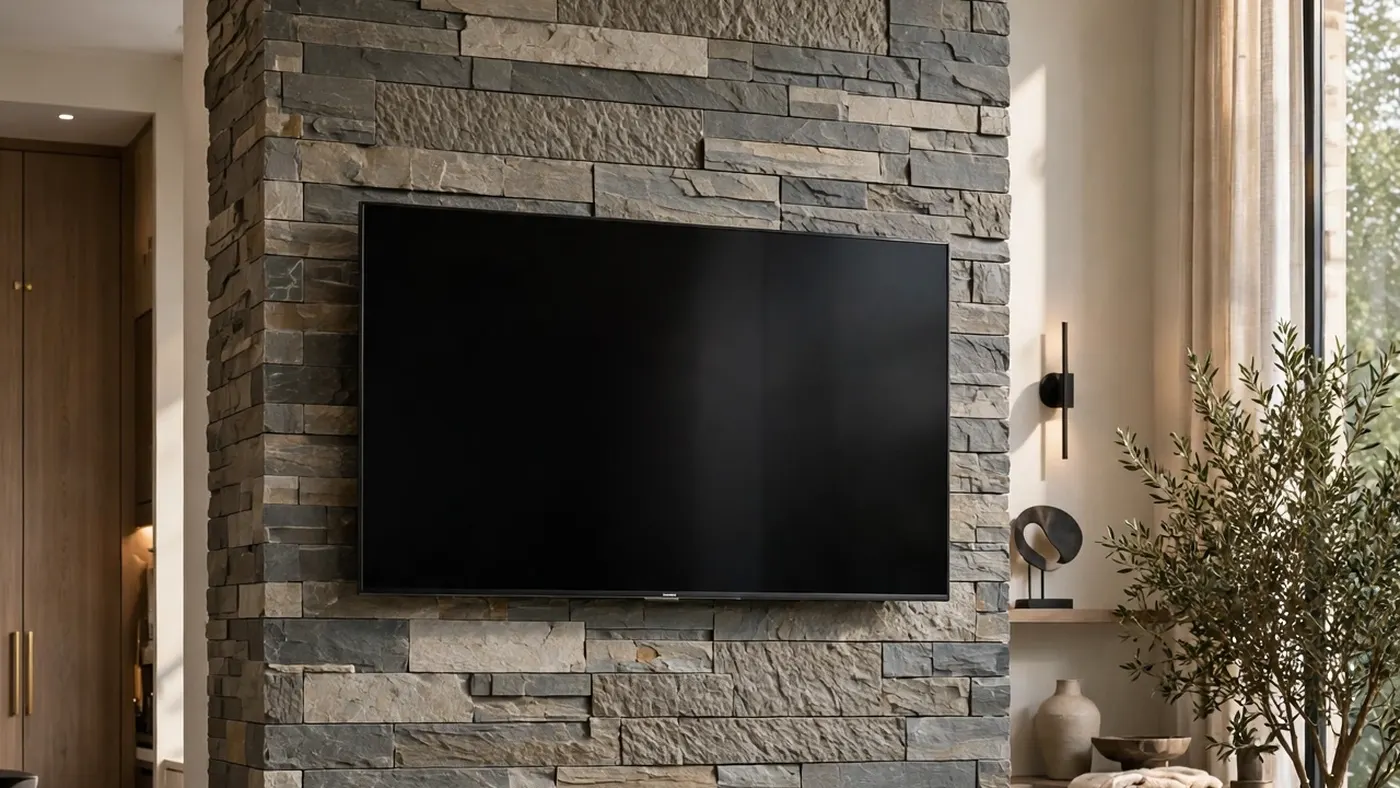
Brick, stone and the fireplace wall
Brick and natural stone turn up in two ways. As genuine structural walls, common in older housing across the country, and as a decorative face on a fireplace surround, common in newer suburban builds.
Both hold weight beautifully. Both look excellent with a screen on them when the position is chosen carefully. The complications are cosmetic rather than structural. Stone in particular is uneven. A ledgestone or stacked-stone face is not a flat plane, and a mount that assumes flatness will sit crooked and look wrong from the doorway. A good installer plans around that, and planning around it takes time.
The other thing to understand is that masonry is permanent in a way drywall is not. Drywall can be patched and repainted in an afternoon and nobody will ever know. A stone or brick face cannot. That raises the stakes on getting the position right the first time, which is why we spend more of the visit on the walkthrough for these walls and far less time being flexible afterwards.
Fireplace walls also bring the height question with them, which is a large enough subject to deserve its own consideration before you settle on a position.
Plaster and lath in older homes
If your home is older, the walls may be plaster over thin wooden strips rather than modern drywall. It looks like an ordinary painted wall and feels harder and more solid than drywall, because it is.
Plaster is perfectly workable and a great many televisions hang beautifully on it. What you should understand is that plaster is brittle and old plaster is unpredictable. It can be sound, or it can be quietly loose from the structure behind it, and you often cannot tell by looking. Cracking or crumbling at the surface is the real risk, and it is a cosmetic risk rather than a safety one.
In practice that means two things. Plaster deserves an installer who has done a lot of it and is willing to work slowly, because speed is what damages these walls. And the space behind plaster is frequently obstructed in ways modern walls are not, so a fully hidden cable finish becomes a question to answer on the day rather than a promise to make on the phone.
Tile, glass and expensive finishes
Tile appears behind kitchen and bathroom screens, on basement feature walls, and increasingly in living rooms finished in large-format porcelain. Marble and quartz slabs show up on modern fireplace surrounds. Occasionally there is glass involved.
These surfaces are all workable. The concern is entirely about the finish. A tiled wall is a set of separate pieces with joints between them, and where the mount lands relative to those joints matters for both appearance and for the tile itself. This is precise, slow work. It is also the category where the difference between a professional and an enthusiastic amateur shows up most visibly and most permanently, because a damaged tile in the middle of a feature wall is not a small repair.
If the wall you have in mind is tile, stone slab or anything else that would be painful and costly to replace, say so at the moment you book. It changes how much time we hold for the job and it changes the conversation about position.
Metal studs
Condos, apartments, offices and most commercial fit-outs use light steel framing behind the drywall instead of wood. From inside the room the two are indistinguishable. Same drywall, same paint, same everything.
Metal framing is entirely suitable for a mounted television, but it behaves differently from wood. It is one of the places where an inexperienced install can look perfect on day one and become a problem a year later, which is why it is not a wall to gamble on and not a wall where the generic hardware in the box is the right answer.
For you the practical implications are mild. It rarely changes the position you can have. It occasionally changes what screen size we would recommend. It sometimes adds time. Hidden cabling inside metal-framed walls is often possible but more constrained, particularly in condo buildings where the same wall may also be a fire separation or a shared wall that cannot be opened at all.
Media walls, false walls and built-ins
This is the option most people do not know exists, and it is the answer to a surprising number of difficult rooms. Rather than fighting an awkward wall, you build a new shallow one in front of it. Sometimes a panel just behind the screen, sometimes a finished feature running the full width of the room.
It solves several problems at once. It creates clean space for cables and equipment where none existed, so a concrete basement or a brick chimney breast can end up with the same completely invisible finish as ordinary drywall. It gives a flat, true surface where the original was uneven. It lets the screen sit exactly where you want it rather than where the building allows. And it looks deliberate: an inset recess, a floating shelf, integrated lighting, a fireplace beneath.
The cost is real. This is carpentry and finishing work rather than a mounting visit, and it is measured in days rather than hours. But for basements, for stone fireplaces people are unwilling to touch, and for anyone who is renovating anyway, it is very often the answer that produces the room they actually pictured.
What to have ready when you book
You do not need to diagnose your wall. You need to describe it. A few sentences and a photograph taken from across the room tell an experienced installer most of what they need, and the rest is confirmed on site before anything begins.
This matters for scheduling. A drywall job and a stone fireplace job are different visits of different lengths, and the worst outcome for everyone is an installer arriving with the wrong amount of time held. If you have no idea what your walls are made of, that is fine and common. Say so, and one photograph is usually enough.
- Say what the wall looks and feels like: a flat painted surface, exposed brick, a stone fireplace face, a tiled panel.
- Say which floor of the building the room is on, and whether it is a basement, because that alone predicts a great deal.
- Say roughly when the home was built, or say that you do not know, which is a genuinely useful answer in itself.
- Mention anything you already know is inside the wall, such as a fireplace flue, plumbing on the other side or a recent renovation.
- Say whether you want the cables completely hidden, because that is the outcome most affected by wall type.
Concrete basements and stone fireplaces, the two Ottawa walls
Two wall types account for most of the complexity in Ottawa installs, and they sit at opposite ends of the house.
The first is the poured concrete foundation wall in the basement. In older Nepean and Alta Vista homes it is sometimes left bare or barely finished. In newer Barrhaven and Kanata builds it is usually framed and drywalled over, which changes the job completely, because a framed-out basement wall behaves much like ordinary drywall and a bare one does not. Homeowners frequently do not know which they have, since both look like a painted wall from the sofa. It is the single most useful thing to establish before booking a basement install.
The second is the stone fireplace surround in the newer suburbs. Ledgestone and cultured stone faces are everywhere in Ottawa great rooms built since around 2005, and they are the reason those jobs run longer. The surface is not flat, the mantel is in the way, the natural position is higher than is comfortable to watch, and there is usually no power anywhere near it. All of that is solvable. The outcomes range from a straightforward mount with a colour-matched surface run to a full false wall built across the feature, but it is a planning conversation rather than a quick visit.
Older central neighbourhoods, particularly the Glebe, Old Ottawa South and parts of Westboro, bring plaster and lath into the mix as well, which is slower and more careful work again.
What this costs in Ottawa
Flat pricing by screen size, taxes and the wall mount quoted before you book. No hourly rate, no surprise line items on the day.
Your exact total, tax included, takes about a minute on the price tool. A $25 deposit holds the slot and comes off the final bill.
Questions we get asked
Can you tell what my wall is made of from a photograph?
Usually we can narrow it down to one or two possibilities, which is enough to schedule the right amount of time. The age of the home and which floor the room is on tell us nearly as much as the photo does. Whatever we think beforehand is confirmed properly on site before any work starts.
Does a concrete or brick wall cost more than drywall?
Yes. Masonry takes longer, it is harder on equipment, and it usually needs a different approach to the cables because there is no cavity inside the wall. Expect a supplement over the standard drywall job. We tell you that at booking rather than at the end.
Is my wall strong enough for a very large television?
Almost certainly. On practically every wall type in a normal home, the question is not whether it will hold the screen but where on that wall the mount can go and how long it takes to do properly. Screen weight is rarely the limiting factor for a professional install. Position and cable concealment are.
What happens if we change our minds about the position later?
On drywall or plaster, the old position is patched and painted and disappears. On brick, stone or tile it does not, which is why we spend longer agreeing the spot on those walls before anything happens. If you think the room might be rearranged in the next couple of years, say so during the walkthrough and we will factor it in.
My condo says I cannot drill into certain walls. Does that end it?
Not usually. It normally means a specific wall, often one shared with a neighbour or a corridor, is off limits while the others are fine. Check the rules with your property manager before you settle on a wall, and tell us what they said. There is nearly always a workable position and a clean way to handle the cables.
Are there walls you will not mount on?
Very few, and we will tell you plainly if yours is one of them. The more common outcome is that a wall is fine to mount on but cannot hide cables inside it, so the conversation becomes about which finish you want instead. Honesty on the day is worth more to us than one extra job.
Our basement is framed and drywalled over concrete. Which type is it for mounting?
For most purposes it behaves like an ordinary drywall wall, which is good news. The variable is how much space there is between the drywall and the concrete, and that differs from builder to builder across Kanata and Barrhaven. We confirm it during the walkthrough because it decides whether the cables can be fully hidden.
Can you mount on the stone fireplace in our great room?
Yes, and we do it regularly across the newer Ottawa suburbs. The two things to think about first are height, because the natural spot above a mantel is usually higher than is comfortable for evening viewing, and cables, because stone hides nothing and there is rarely an outlet up there. Both are much easier to plan before install day.
Ready to get it on the wall?
Answer a few questions and you will see your exact total, taxes in, before you book anything. Book now, mounted today, not next week.