Ottawa homes tend to ask two very different things of a television mount, and most households here end up needing both answers at some point. Downstairs, in the finished basements that come standard with almost every detached home from Nepean through Kanata, the constraints are ceiling height and bulkheads. A duct run crossing the room can push a screen higher than anyone wants, and a rec room built for hockey nights and long winter afternoons is a room where getting the angle right actually matters.
Upstairs, especially in the newer great rooms of Barrhaven, Stittsville and Orleans, the constraint is the fireplace. A tall stone or tile feature wall with a mantel and a raised hearth sets the height before anyone has chosen a bracket, and the mount then has to do the work of making that height liveable. Add the older brick homes in the Glebe and Westboro, with their small rooms and awkward corners, and you have a city where the default flat mount is frequently not the right call. Choosing well here starts with knowing which of those three rooms you are standing in.
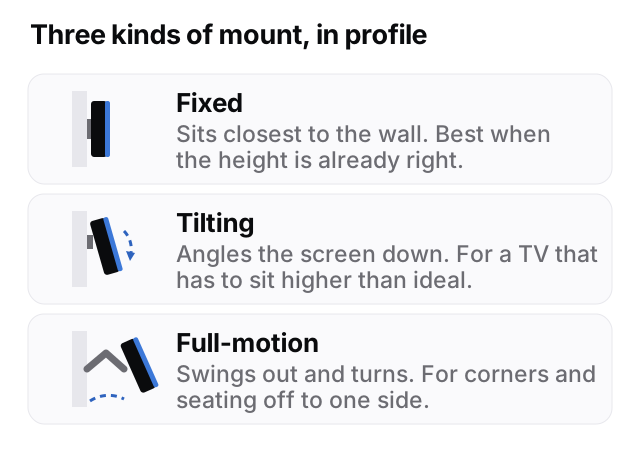
There are really only three questions
The wall of mounts in a shop looks like dozens of different products. It is not. Every mount answers three questions and nothing else: how close to the wall the screen sits, how much it can move once it is up there, and what it is attaching to. Once you know your answers, the choice narrows to two or three options and the rest stop mattering.
The mistake almost everyone makes is choosing on features. A mount that swings, tilts, rotates and extends sounds better than one that does none of those things, and in the wrong room it is worse. Movement costs you depth off the wall, and depth is the one thing you cannot get back later. The best mount for a room is usually the simplest one that solves the actual problem.
Fixed and low-profile mounts
A fixed mount holds the television flat and still, as close to the wall as the design allows. Nothing moves. That sounds limiting and it is the right answer more often than any other type, because it delivers the look most people actually want: a screen that sits against the wall like a framed picture, with no shadow gap and no visible hardware.
It suits any room where the seating is settled and everyone watches from roughly the same place. A living room with a sofa facing the wall. A bedroom where the bed does not move. A basement with a sectional along one side. If your seating is fixed and the height is right, movement buys you nothing and costs you a clean look.
The trade-off is real, though. A flat screen sitting tight to the wall is harder to reach behind, which matters if you swap sources regularly. And it commits you. Once it is up, the viewing angle is the viewing angle, so the height and the wall have to be right the first time. That is a planning problem more than a hardware problem, and it is exactly why the height conversation happens before anything is chosen.
Tilting mounts
A tilting mount holds the screen close to the wall but lets it pitch downward, so a television placed above eye level can be aimed back at the people watching it. It sits a little further off the wall than a fixed mount, but not dramatically so, and it keeps most of the clean look.
The honest use for a tilt is compensation. It is what you choose when the screen has to go higher than ideal, which in practice means over a fireplace, above a bar, high on a kitchen wall, or in a basement where a bulkhead forces the issue. Angling the picture down reduces the neck strain and improves how the image looks from a seated position, because most screens lose contrast and colour accuracy when you view them from far off centre.
What a tilt does not do is rescue a genuinely bad height. If the screen ends up so high that you are looking up at it all evening, tilting it makes the picture better without making the room better. The strongest advice we give is to solve the height first and treat tilt as the finishing adjustment, not as the plan.
Full-motion and articulating mounts
A full-motion mount is on an arm. It extends out from the wall, swivels left and right, and usually tilts as well, so the screen can be aimed at a different part of the room or pulled out and turned entirely. Folded flat it sits noticeably further from the wall than a fixed mount, and that gap is the price of admission.
It earns its place in rooms with more than one viewing position. An open-plan kitchen and living space where you watch from the island while cooking and from the sofa afterwards. A room with a bright window, where being able to angle away from a reflection is genuinely useful. A corner installation. A bedroom where you watch from the bed and from a chair. Anywhere the screen has to serve two places, an arm is the answer.
Full-motion mounts also make it much easier to reach behind the screen, which matters more than people expect in a setup with a lot of connected equipment. The costs are the standoff gap, more visible hardware, and a greater dependence on what the wall is made of, because a screen held out on an extended arm places very different demands on a wall than one sitting flat against it. That is a question for the installer, and it is one of the first things we check.
Ceiling, pole and other specialty mounts
Sometimes there is no good wall. A screen hung from the ceiling solves that, and it turns up more often than you would think: in kitchens where every wall is cabinetry, in basements with a wall of windows, in gyms and workshops, in commercial rooms, and in open spaces where the screen needs to float rather than sit against something.
Related options cover the same territory in different ways. There are mounts that carry two screens on one structure, mounts designed to sit neatly into a corner, low-profile outdoor mounts for covered patios, and mounts built to place a screen at standing height in a bar or a games area. There are also pull-down systems that bring a high-mounted screen down and forward into a comfortable viewing position, which is the most convincing answer we have found to a screen that genuinely must live above a fireplace.
The specialty options are worth knowing about because most people do not know they exist and settle for a compromise instead. If your room has no obvious wall, say that out loud before assuming the television has to sit on furniture.
Matching the mount to the room
The room usually chooses for you once you describe it honestly. A few patterns come up again and again in the homes we work in.
- A living room with settled seating facing one wall almost always wants a fixed mount, because the clean flush look is the whole point and nothing needs to move.
- A family room built around a fireplace usually wants a tilt at minimum, and is often better served by a pull-down system or by moving the screen to a different wall entirely.
- An open-plan kitchen and living space wants an arm, because you are watching from two places that are nowhere near each other.
- A bedroom is nearly always fixed or tilting, since the viewing position is the bed and it does not move.
- A basement with low ceilings or a bulkhead usually needs a tilt to bring the picture back down to the seating.
- A room where the equipment changes often benefits from an arm regardless of viewing angle, simply because getting behind the screen stops being a project.
The wall has a say in this
Mount choice is not made in isolation. What the wall is built from affects how much movement it can reasonably support, how far a screen can safely extend from it, and in some cases how large the television can be. Drywall over wood framing, plaster over lath, poured concrete, block, brick veneer and stone all behave differently, and a mount that is straightforward on one is a considered decision on another.
This is why we assess before recommending rather than the other way round. A good installer wants to know what the wall is, what is behind the finished surface, whether it is flat and true, and what the room is asking the mount to do. Those four answers usually settle the choice within a minute or two.
None of it should worry you. Nearly every wall in nearly every home can carry a properly chosen mount. It simply means the honest sequence is room first, wall second, mount third, and that anyone who quotes you a mount type over the phone without asking about the wall is guessing.
What people actually regret
The most common regret by a wide margin is buying a full-motion mount for a room that never needed one. The screen sits further off the wall than expected, the arm is visible from the side, and in years of use it gets moved perhaps twice. People wanted the option and paid for it in appearance every single day.
The second most common is the opposite: a fixed mount on a wall that turned out to be too high or too bright, with no way to adjust once it is up. That is a planning failure rather than a hardware failure, and it is almost always avoidable with one honest conversation about seating and light beforehand.
The third is choosing a mount that does not suit the screen it is holding. Larger and heavier televisions are less forgiving, and a mount that technically fits can still leave a screen that flexes when nudged or sags slightly over time. The fix is not clever. It is matching the mount properly to the television and the wall at the start, which is the part of the job most worth handing to someone who does it constantly.
How we choose one for you
We start by sitting where you sit. Everything else follows from viewing position, viewing distance and the light in the room at the time you actually watch. Then we look at the wall and confirm what it will comfortably support. Then, and only then, does the mount type get decided.
If two options would both work, we will say so and tell you what each one gives up. Most homes end up with something simpler than the customer expected, and that is usually the right result. The mount is a means to an end. What you want is a screen at the right height, on the right wall, that looks like it belongs there and still feels solid in ten years.
Which mounts suit Ottawa rooms
Tilting mounts do more work in Ottawa than in most cities, and the reason is the basement. Lower ceilings and bulkheads carrying ductwork mean a screen often sits higher than the seating would prefer, and a modest downward angle brings the picture back to where a sectional actually is. It is a small adjustment that changes the feel of a five-hour movie night considerably, and in a city where the basement is the main room from November through March, that adds up.
The great-room fireplace is the other Ottawa signature, and it is where full-motion and pull-down options earn their keep. In a Barrhaven or Kanata open plan, the seating is usually far enough back that a tilt alone is manageable, but the higher and deeper the mantel, the more a pull-down system starts to make sense. It brings the screen down and forward for watching and returns it flush when you are finished, which is a better outcome than accepting a permanently high picture.
Full-motion arms come up most often in the open kitchen-and-family-room layouts that dominate newer Ottawa builds. If you cook while the game is on, an arm lets one screen serve the island and the sofa. And in the older central neighbourhoods, corner mounts get more use than you might expect, because small rooms with radiators, bay windows and original trim leave very little flat wall to work with.
What this costs in Ottawa
Flat pricing by screen size, taxes and the wall mount quoted before you book. No hourly rate, no surprise line items on the day.
Your exact total, tax included, takes about a minute on the price tool. A $25 deposit holds the slot and comes off the final bill.
Questions we get asked
Do I actually need a full-motion mount?
Only if you watch from more than one position, or if you need to angle away from a window, or if you reach behind the screen often. If the sofa faces the wall and that is where everyone sits, an arm gives you flexibility you will rarely use in exchange for a screen that stands further off the wall permanently. We would rather talk you out of one than sell you a compromise.
Will a tilting mount fix a TV that is mounted too high?
It improves the picture but not the posture. Tilting aims the screen back at you, which restores contrast and colour that you lose when viewing from far off centre, and that is a genuine benefit. It does not change the fact that you are looking upward all evening, so tilt is best treated as a refinement to a good height rather than a rescue for a bad one.
Can I change to a different mount type later?
Yes, and it happens fairly often, usually when a room gets rearranged or a larger television arrives. Swapping mount types is straightforward work, though the new mount may not line up with the previous fixings, so plan for some wall repair and paint. If you think a change is likely, it is worth mentioning at the first install.
Do larger televisions need a different kind of mount?
They need a mount properly matched to them, which is not the same as the largest mount available. Bigger screens are heavier and less forgiving, they put more demand on the wall, and they show any slight tilt or sag much more obviously. We match the mount to the specific screen and the specific wall rather than working from a general rule.
How far off the wall will my TV sit?
It depends entirely on the type. A low-profile fixed mount keeps the screen tight against the wall, a tilt adds a small amount, and a full-motion mount stands noticeably further out even when folded flat. If the flush look matters to you, say so early, because it eliminates some options straight away and makes the rest of the decision easier.
Is the mount that came with my TV good enough?
Sometimes, and sometimes not. Included mounts are usually basic fixed brackets chosen to suit the average wall rather than yours. We are happy to use one if it genuinely suits your television and your wall, and we will tell you plainly if it does not rather than fitting something we would not want in our own home.
Our basement has a bulkhead across the room. Does that change the mount?
Usually it does. Bulkheads in Ottawa basements often sit exactly where the screen would ideally go, which pushes the television higher and makes a tilting mount the sensible choice. We look at the bulkhead, the ceiling height and where your seating actually is before recommending anything, because sometimes a different wall solves it outright.
Is a pull-down mount worth considering for a fireplace in a newer Ottawa home?
It is worth a serious look if the mantel is tall and the seating is close. Many Barrhaven and Kanata great rooms have feature walls that place a screen well above comfortable eye level, and a pull-down brings it into a proper viewing position without giving up the look when it is not in use. We assess the wall first, since these systems ask more of it than a flat mount does.
Ready to get it on the wall?
Answer a few questions and you will see your exact total, taxes in, before you book anything. Book now, mounted today, not next week.