Ottawa homes make the cost of a television installation unusually easy to explain, because so much of the housing stock falls into a few clear patterns. A 1970s Nepean or Alta Vista bungalow with a finished basement. A 1990s Kanata two-storey with drywall throughout and a modest family room. A newer Barrhaven or Stittsville build with a great room, a high ceiling and a stone or tile fireplace front sitting exactly where everybody wants the television. Each of those is a different quote, and the difference is mostly the wall.
Winter shapes the rest. The basement rec room does more work here than in most cities, because from November to April it is where the hockey gets watched, and basement walls in this city are frequently poured concrete rather than framing and drywall. Home offices are everywhere in a government town, and a second screen in a spare bedroom is a common part of the same visit. Add Gatineau across the river, older Glebe and Westboro houses with plaster, and Orleans subdivisions with open-plan main floors, and you have a region where the honest answer to what does it cost is always another question about the wall.
Why two quotes for the same job look nothing alike
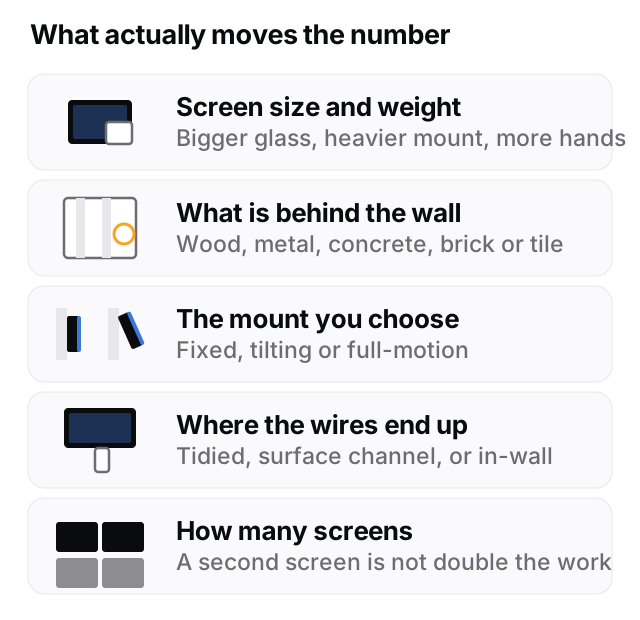
A television installation sounds like one fixed task. The screen goes on the wall. In practice it is a short stack of decisions, and every one of them moves the figure at the bottom of a quote. Two houses on the same street can be quoted very differently for what looks like an identical job, and both quotes can be completely honest.
The difference is almost never the screen. It is the wall, the mount, the wires, the height, the access, and how much of the room has to be put back together afterwards. Once you can see those pieces separately, a quote stops being a single mysterious number and becomes a description of the work.
There are no figures in this article on purpose. Our current pricing lives elsewhere on the site, and that is the right place to look for it. What follows is the reasoning underneath any price, so you can compare two quotes on what they actually contain rather than on which one is smaller.
Screen size, and the weight nobody asks about
Size is the first thing everyone mentions and the least useful number on its own. A modern large panel can be lighter than a smaller set from a decade ago, and weight is what the wall and the mount actually care about. What size does change is handling. Past a certain diagonal a screen stops being something one person can safely lift, position and hold steady, and a second installer is on the job whether or not the wall is difficult.
Large screens are also less forgiving about placement. A small bedroom television sitting a few centimetres off centre reads as fine. A very large screen on a feature wall reads as crooked from the doorway, so more time goes into setting it out and checking it from where people will actually sit.
When you ask for a quote, give the model number rather than just the size. It tells an installer the weight, the mounting pattern on the back, where the ports are, and whether the panel is one of the very thin designs that needs extra care.
What is behind the drywall
This is the biggest single swing in most quotes. A standard wood-framed wall with drywall over it is the baseline, and most quotes assume it unless you say otherwise.
Everything else is a different job. Poured concrete and concrete block, common in basements and in tower construction, take longer and use different fixings. Brick and stone, including the front of a fireplace, are slower again and demand far more care because mistakes there are visible forever. Plaster over lath, standard in pre-war houses, hides its structure differently and has a habit of surprising people. Steel-framed partitions in offices and newer condos behave differently under load than wood. Tile over any of the above adds its own risk.
You do not need to identify your wall correctly. You do need to tell an installer what you think it is and let them confirm before anything starts. A good one will ask before quoting, will check on arrival, and will tell you straight away if what they find changes the plan. Quoting a stone fireplace as though it were drywall is how people end up with an unpleasant conversation halfway through the afternoon.
The mount you choose
Mounts are not interchangeable, and the gap between the simplest and the most involved is one of the larger line items on a quote.
A fixed or low-profile mount holds the screen flat and close to the wall. It is the simplest to fit and the least expensive to buy. A tilting mount adds a little downward angle, which matters when a screen sits higher than ideal. A full-motion mount puts the screen on an arm so it can be pulled out, swivelled and angled, which is the answer for corners, kitchens and rooms with more than one seating position. It costs more as hardware and takes longer to fit because it has to carry the screen out away from the wall as well as against it.
Beyond those there are pull-down mounts that bring a screen down from above a fireplace to eye level, recessed installations that set the screen into the wall so it sits nearly flush, ceiling and pole mounts, and outdoor-rated hardware. Each of those is a bigger piece of work, and each should be named on the quote rather than described simply as a mount.
Where the wires end up
Wire concealment is the part homeowners underestimate most, and it is the difference between an installation that looks finished and one that looks like a television bolted to a wall.
There are broadly three outcomes. Leave the cables visible, which adds nothing and looks like what it is. Run them inside a slim surface channel fixed to the wall and painted to match, which is tidy, quick, and works on walls where nothing can go inside them. Or conceal them fully inside the wall so nothing shows between the screen and the equipment below, which is what most people picture when they say they want the wires hidden.
Full concealment is more work and it is not always available. Masonry, some condo walls and fireplace fronts can rule it out. It also raises the question of power, because a television's power supply is a separate consideration from the signal cables, and sometimes the right answer is a new outlet behind the screen. That is worth knowing before you book, not on the day.
More than one screen
A second screen in the same room, on the same wall type, on the same visit, is not double the work. The travel, the setup, the dust sheets and the tidy-up all happen once. Most quotes reflect that, and if you are planning a second television anywhere in the house it is usually worth doing both on one visit.
What does not shrink is a screen in a different room on a different wall with a different mount. That is a second job which happens to share a driveway. A bedroom screen above a dresser and a great-room screen over a stone fireplace have almost nothing in common except the address.
Matched arrays, where several screens have to line up as a single visual unit, are their own category. The tolerance for error drops to almost nothing and the layout work becomes a real part of the job.
The room, and getting into it
Access is invisible on a quote until it is missing from one. Stairs, a booked elevator, a loading dock with a time window, parking that has to be arranged, an exterior staircase, or a basement with a ceiling low enough to make a large screen awkward to turn all cost time.
So does the room itself. Furniture that has to be moved and put back. A fireplace that puts the screen high enough to need a lift. A finished basement where the space behind the wall is not what it looks like. A brand-new room where the paint is fresh and everything has to stay clean.
None of this is dramatic and none of it should be a surprise. It is simply why a good installer asks about the room and not only about the television. If nobody asks you anything about the space, the quote you are being given is a guess.
Extras that should be itemised, not assumed
These are small pieces individually. Together they are often the whole gap between two quotes that looked identical at first glance. Each should appear as its own line so you can decide whether you want it.
None of these are upsells in the bad sense. They are the reason a finished wall looks finished. But they are optional, and you should be able to see them listed separately and take them or leave them.
- Mounting a soundbar underneath the screen so it sits level and centred instead of balancing on a shelf.
- Fitting a floating shelf or a concealed bracket for a streaming box, a games console or a receiver.
- Adding bias lighting behind the panel, which changes how a room feels far more than most people expect.
- Taking down an existing television and its old mount, then filling and making good the holes it leaves.
- Removing and responsibly disposing of an old set that is being replaced.
- Connecting sources, signing into apps and setting the picture up properly rather than leaving it on the showroom preset.
How to read a quote, and what a cheap one leaves out
A quote worth trusting describes the job. It names the mount, states the wall type it assumes, says whether wire concealment is included and which kind, says how many installers are coming, and says what happens if the wall turns out to be something else. It also says what is not included.
A quote dramatically lower than everything else is usually not a better deal, it is a shorter list. The mount itself is frequently excluded. So is concealment, patching, disposal, a second installer for a large screen, and any real commitment to the figure surviving contact with your wall. The number that matters is the one you pay when the work is done, and doorstep re-quoting is a business model. Ask these before you book.
Any installer comfortable with those questions will answer them quickly. Hesitation is information.
- Does this include the mount, or am I supplying it?
- What wall type are you assuming, and what changes if it is different?
- Is wire concealment included, and is that inside the wall or in a channel on the surface?
- Will there be a second installer for a screen this size?
- Do you patch and make good where an old mount came off?
- Are you insured, and do you warrant the workmanship?
What moves the number in Ottawa homes
The poured-concrete basement wall is the most common reason an Ottawa quote is higher than the homeowner expected. It is completely routine work, and it is also slower and harder on materials than drywall over framing. Any quote that does not distinguish between the two was not written for your house.
The second is the fireplace. Newer Barrhaven, Stittsville and Kanata builds put a fireplace on the feature wall of the great room with stone, stacked tile or masonry across the front, and that is where the television is going. Working on that surface is careful work, the height usually calls for a tilting or pull-down mount so the picture is not aimed at the ceiling, and concealing the wires needs a plan made before anyone starts rather than during.
Third is simply how many screens. Ottawa households routinely end up with a great-room screen, a basement screen and a home-office screen, and doing them across one visit rather than three is the closest thing to a discount that exists in this trade.
Fourth is access in winter. A cleared driveway and a clear path to the door genuinely saves time in February, and time is what you are paying for.
What this costs in Ottawa
Flat pricing by screen size, taxes and the wall mount quoted before you book. No hourly rate, no surprise line items on the day.
Your exact total, tax included, takes about a minute on the price tool. A $25 deposit holds the slot and comes off the final bill.
Questions we get asked
Why do you need to know my wall type before quoting?
Because it is the single largest variable in the work. Drywall over wood framing, poured concrete, brick, stone and plaster over lath are four genuinely different jobs. Telling us what you think the wall is lets us give you a figure that will still be right when we arrive.
Does the mount come with the installation, or do I buy it separately?
It can be either, and the quote should say clearly which it is. If you have already bought a mount we will check it suits your screen and your wall before we use it. If you have not, we will recommend the right type for the room rather than the cheapest one on the shelf.
Can the wires always be hidden inside the wall?
No. Masonry, concrete, some condo walls and many fireplace fronts rule it out, and building rules sometimes do too. In those rooms the answer is a slim surface channel painted to match the wall, which looks clean and finished. We tell you which applies before the day, not during it.
Will you take away my old TV and the old mount?
Yes, if you ask for it. Takedown, removal and responsible disposal are separate items so you can choose them, and we will patch and make good the holes the old mount leaves. It is much easier done in the same visit than arranged later.
What happens if the job turns out to be harder than expected?
We tell you before we start, not afterwards. If we open up a wall situation that is genuinely different from what was described, we explain the options and what each one means, and you decide. Nobody should ever be presented with a changed figure after the work is finished.
Is it cheaper to have more than one TV done at once?
Usually, yes, because the travel, setup and cleanup happen once instead of twice. The saving is largest when the screens are in the same room or on similar walls. A second screen in a different room on a different wall type is closer to a second job, so the saving is smaller.
Is a basement wall in an Ottawa home usually concrete?
Very often, yes, particularly the foundation walls of homes built from the 1960s onward. Interior partition walls in a finished basement are usually framed and drywalled, so it depends which wall you want the screen on. Tell us which one it is and we will tell you what it changes.
Do you quote differently for Gatineau or the outer suburbs?
The work itself is quoted the same way across the region. What changes is scheduling, since crossing the river or heading out to Stittsville or Orleans fits some parts of the day better than others. We tell you up front if anything about your address affects the visit.
Ready to get it on the wall?
Answer a few questions and you will see your exact total, taxes in, before you book anything. Book now, mounted today, not next week.