The Ottawa room where this question comes up most is the basement. Finished rec rooms across Nepean, Alta Vista and the older parts of Kanata are where families here genuinely spend the winter, and they are also the rooms with the fewest outlets, the lowest ceilings and, very often, a concrete foundation directly behind the wall. Whether that basement wall was framed out in front of the concrete or fixed straight onto it decides almost everything about what can be hidden.
Upstairs the question changes completely. Newer Barrhaven, Stittsville and Kanata great rooms usually put the fireplace on the feature wall with a stone or tiled face, a mantel in the way, and no power above it at all. That combination of a hard surface, a high position and no outlet is the most common cable problem in this city. It is also the one most worth planning properly before install day, because none of it improves by being solved in a hurry with an installer standing in your great room.
Why this is the part people regret
Almost nobody calls us because their cables bother them. They call because they want the television on the wall. Then the screen goes up, they sit down on the sofa, and the first thing their eye finds is the loop of black cable hanging down to the outlet.
A mounted television with visible wires is a job that is half finished. The entire reason to put a screen on a wall is so it looks like part of the room rather than something parked in front of it, and a dangling cord undoes that instantly. It is also the most common thing people ask us to come back and fix.
The good news is that this is solvable at several levels of effort and cost, on almost every wall in almost every building. The catch is that some options have to be chosen before the screen goes up rather than after.
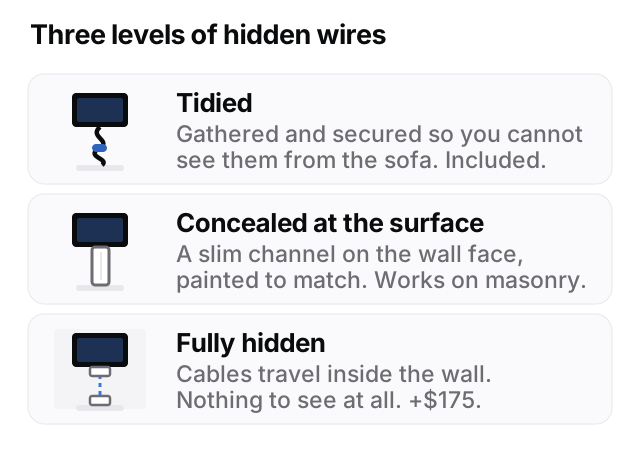
When people say they want the wires hidden, they usually mean one of three quite different things. Being clear about which one saves a great deal of confusion and disappointment.
- Tidied means the cables are gathered, shortened and secured so they are no longer visible from where you sit, with nothing built and nothing opened.
- Concealed at the surface means the cables run inside something slim fitted to the face of the wall and painted to match, so you see a clean line rather than a bundle of wires.
- Fully hidden means the cables travel inside the wall itself, so there is nothing whatsoever to see between the screen and wherever the equipment lives.
Choosing between the three
All three are legitimate finishes and all three are things we do every week. The third is the one most people picture when they imagine the room. It is also the most expensive and it is not available on every wall.
The second gets you most of the visual benefit for a fraction of the effort, and it is reversible, which matters more than people expect. The first is often enough on its own in a room where the equipment sits directly beneath the screen anyway, because there is very little cable to hide in the first place.
The useful question is not which one is best. It is how much the wall is worth to you. A main living room that you look at every evening for the next ten years justifies more than a bedroom screen you watch for twenty minutes before falling asleep.
Surface concealment
A surface solution carries the cables inside a slim enclosure fixed to the face of the wall between the screen and the equipment. Painted the colour of the wall, a good one reads as a faint shadow line rather than an object, and from across a normal room most people do not notice it at all.
Its real advantages are practical. It works on concrete, brick, stone and tile, where nothing can go inside the wall. It works in condos where opening a wall is not permitted. It works in rented homes where the wall has to return to normal at the end of the lease. And it can be altered later, because whatever device you add in two years still has to reach the screen somehow.
The honest limitation is that it is visible if you go looking for it, particularly on a textured or patterned wall. On a plain painted wall, well fitted and properly painted, it effectively vanishes at normal viewing distance. On a stacked stone fireplace it does not, so stone walls usually push people toward building something out instead.
The fully hidden finish
On a standard interior wall with usable space inside it, cables can travel within the wall between the screen and a point lower down. The result is a completely clean face. Screen, wall, nothing else. This is the finish that makes people stop in the doorway when they walk in.
It takes longer and costs more than a surface run, and in a room you genuinely care about it is worth it. It is unobtrusive and easily made good if the room ever changes.
There are real limits. Some walls are not hollow at all. Some hollow walls are obstructed by earlier work. Fire separations and walls shared with a neighbour or a corridor often cannot be opened in any circumstances. Exterior walls are a separate conversation again because of insulation and moisture. An honest installer confirms what is achievable on site before committing, rather than promising an invisible finish on the phone and discovering on the day that the wall does not cooperate.
One more thing is worth knowing. Full concealment is far easier when the equipment ends up somewhere sensible. A screen on one wall and the equipment in a cupboard across the room is a much larger job than a screen and its equipment on the same wall.
Power is the part everyone forgets
There are two kinds of cable behind a television and they follow completely different rules. The signal cables, the ones carrying picture and sound from your box, your console or your soundbar, are low voltage and comparatively simple to deal with. The power cable is not.
Putting an ordinary power cord or an extension lead inside a wall is not acceptable, and any installer who offers to do it is telling you something important about the rest of their work. Getting mains power to a point behind the screen properly is electrical work. Depending on the situation it is either a purpose-made solution fitted as part of the job or a task for a licensed electrician, and we will tell you plainly which one your room needs.
For your planning the implication is simple. If there is no outlet near where the screen is going, raise it when you book rather than on the day. It affects how long the visit takes, what it costs, and occasionally whether the position you want is the position you should choose. A great many awkward installs would have been easy if the outlet had been mentioned a week earlier.
An outlet behind the screen is a good idea regardless of concealment. It keeps the run short and makes every future change simpler.
Where the equipment lives
Cable management is not only about the wall. Half the visual mess in a typical setup is at floor level: the tangle behind the console, the power bar, the modem, the adapters.
There are three broad answers. Equipment directly beneath the screen on a low console or a floating shelf, which keeps every run short and is by far the simplest thing to make invisible. Equipment in a nearby cabinet or cupboard, which is tidier still but means longer runs and some thought about how remote controls will reach. Or equipment gone entirely, with a modern screen doing its own streaming and only sound and power left to deal with.
That third option is far more realistic than it used to be, and for a lot of households it is the cleanest answer available. If the only things on the wall are a screen and a soundbar, the wiring problem shrinks to almost nothing. It is worth asking yourself honestly which boxes you still use.
The floating shelf below the screen is the underrated choice. It removes a piece of furniture from a small room, lifts the equipment off the floor, and gives every cable a short, straight, hidden path.
What your wall and your building allow
Wall type is the main constraint and it divides simply. Hollow walls with usable space inside can take a fully hidden finish. Solid walls, meaning concrete, block, brick and stone, cannot, so the answer there is a surface run or building something out from the wall.
Building type adds a second layer. Condos and apartments frequently restrict what may be opened, especially any wall shared with a neighbour or a corridor. Older houses have interiors cluttered by a century of previous work, which is invisible from the room and decisive on the day. Exterior walls involve insulation and moisture and are treated carefully everywhere in this country.
The third option, and the one people rarely think of first, is to change the wall rather than work around it. A shallow built-out panel, or a full media wall across the feature, creates clean space where none existed. That means a stone fireplace or a concrete basement can end up with exactly the same invisible finish as ordinary drywall. It is a bigger project and it is measured in days rather than hours. It is also frequently the right answer in the rooms people care most about.
Decide these before install day
Most of the cable decisions are cheap to make in advance and expensive to make late. A short conversation at booking is worth more than an hour of improvising in your living room.
- Decide which of the three levels of hidden you actually want, and say so when you book.
- Work out where the equipment is going to live before the screen position is fixed, because the two decisions depend on each other.
- Check whether there is an outlet near the intended position, and tell us either way.
- Think about what you might add over the next few years, since allowing for it now costs almost nothing.
- If you are in a condo or renting, find out what your building or landlord permits before you settle on a finish.
What a good result looks like
The measure is simple. Stand in the doorway and look at the wall. If your eye goes to the picture and stays there, the job is right. If it goes to a cable, or a bracket, or a bright white line running down a grey wall, something was left undone.
Good concealment is quiet in a second way too. Nothing is under tension, nothing is stretched tight around a corner, and nothing has to be dismantled violently the next time a device gets swapped. Cables that are hidden but unreachable are a problem waiting for a rainy Sunday.
So ask, at handover, how you get back to the cables if you ever need to. There should be a straightforward answer. If there is not, the job was done for the photograph rather than for the years afterwards.
Concrete basements, stone fireplaces and the outlet that is not there
Two Ottawa situations account for most of the cable conversations we have.
The basement first. If the foundation wall has been framed and drywalled, as most finished Ottawa basements built since the 1990s have been, there is usually some usable space behind the finish and a fully hidden result is often achievable. If the drywall sits directly against the concrete, or the wall is bare block, there is nowhere for a cable to go and the honest answer is a surface run or a built-out panel. Homeowners frequently cannot tell which they have. It is confirmed during the walkthrough, and it is why we ask about the basement specifically when you book.
The great room fireplace is the other. Ottawa builds from roughly 2005 onward put a stone or tile face on the feature wall with the television position above it, and the wiring there is a design problem rather than a technicality. There is usually no outlet above the mantel, the surface will hide nothing, and the equipment is meant to sit in a cabinet to one side. The realistic options are a surface run colour-matched to the stone, a hidden route through the ordinary drywall beside the fireplace, or a full media wall built across the feature, which is what many Ottawa homeowners choose when they are renovating anyway.
In the older central neighbourhoods, the Glebe and Westboro in particular, plaster walls with obstructed interiors are the constraint, and full concealment is a question answered on site rather than in advance.
What this costs in Ottawa
Flat pricing by screen size, taxes and the wall mount quoted before you book. No hourly rate, no surprise line items on the day.
Your exact total, tax included, takes about a minute on the price tool. A $25 deposit holds the slot and comes off the final bill.
Questions we get asked
Can wires be hidden inside any wall?
No, and anyone who says otherwise has not looked at your wall yet. Solid walls such as concrete, brick and stone have nothing inside them to use, and some walls in apartment buildings are not permitted to be opened at all. In those rooms the answer is a surface run or building something out from the wall, both of which can look excellent.
Is a surface channel actually noticeable?
On a plain painted wall, properly fitted and painted to match, most visitors never spot it. From a sofa two or three metres away it reads as a shadow line. Where it does show is on textured, patterned or stone surfaces, and in those rooms we would usually suggest a different approach.
Do I need an electrician for this?
Only if there is no suitable power near where the screen is going, or if you want a new outlet added behind it. Signal cables are a different matter and are part of the install. We will tell you at the walkthrough which situation you are in, and it is much better known at booking than discovered on the day.
Can wires be hidden in a rented home?
Surface concealment is generally fine and reversible, and most landlords have no issue with it. Running cables inside a wall is a bigger ask and should be agreed with your landlord in writing beforehand. Sort that out before the date is booked and the day itself becomes simple.
Can this be done after the television is already mounted?
Yes, and we do it often. It costs more than doing it in the same visit, because the screen has to come off the wall and go back on again. If you are even slightly inclined toward hidden cables, it is much cheaper to decide before the first install than after.
What about a stone or tiled fireplace where nothing can go inside the wall?
There are three usual answers. A surface run in a colour matched to the stone, a concealed route through an adjacent section of ordinary wall beside the fireplace, or building a shallow panel out across the feature so there is somewhere clean for everything to go. The third is a renovation rather than an install visit, and it is what a lot of people eventually choose.
Our basement wall is concrete. Can the cables still be hidden?
Not inside the concrete itself, but you have two good options. A slim surface run painted to match the wall is quick and effective in a rec room. A shallow built-out panel costs more and gives you a completely clean result plus somewhere tidy for the equipment. If your basement was framed and drywalled over the foundation, there may be usable space behind it, and we confirm that on the day.
There is no outlet above our fireplace. What does that mean for us?
It means an electrician is probably part of the plan, and it is much better arranged before install day than discovered on it. It is extremely common in Barrhaven, Stittsville and Kanata great rooms built in the last twenty years. Mention it when you book and we will tell you what your options are and roughly what sequence to do things in.
Ready to get it on the wall?
Answer a few questions and you will see your exact total, taxes in, before you book anything. Book now, mounted today, not next week.