Ottawa watches television in the basement. In Barrhaven, Kanata and Orléans the finished lower level is where the big set lives, and it is where a family spends five months of the year with a hockey game on. Those rooms are also the hardest rooms in the house to get sound right in. Ceilings are low and often carry a drop grid or a boxed-in duct across the middle of them. At least one wall is poured concrete with a stud wall built in front of it. The floor is a slab under laminate or thin carpet. It is a hard, boxy, reflective space, and it is in use constantly from October to April.
Upstairs is the opposite problem. Newer builds in Stittsville and south Barrhaven have great rooms with two-storey ceilings, a stone fireplace on the feature wall and an open sightline through to the kitchen. Sound in a room like that leaves upward and sideways and never comes back. Older stock in the Glebe, Westboro and Alta Vista sits between the two, with plaster, smaller rooms and enough furniture to absorb something. Three different acoustic situations across one city, three different answers, and one thread running through all of them. In Ottawa the television is usually not the problem.
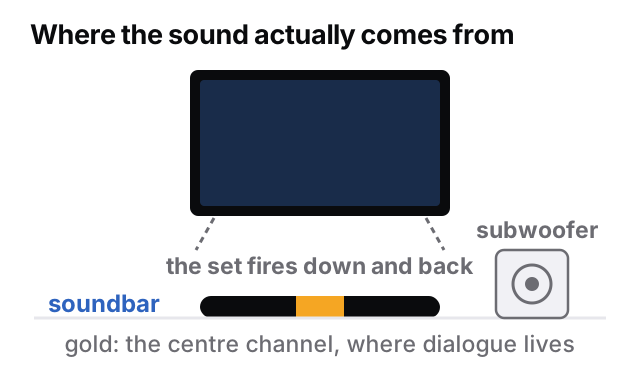
The speakers are not where you think they are
A modern television is mostly screen. Behind that screen there is very little room for anything that has to move air, so the speakers end up as small drivers tucked along the bottom edge or the back panel, firing down at the floor or backwards at whatever happens to be behind the set. Manufacturers know this. It is the compromise that lets a 65-inch panel be thinner than a paperback.
On a stand, that compromise is partly hidden. The set sits low, sound bounces off the top of the console and off the wall a few centimetres behind it, and it arrives at the couch roughly the right way up. Lift the same television onto a wall and you remove every one of those helpful surfaces at once. Down-firing drivers now fire at bare drywall from well above head height. Rear-firing drivers fire into a gap you could not fit a hand into. Nothing has broken and nothing is defective. The television is simply doing the same thing it always did, in a room that no longer supports it.
Why the complaint is almost always dialogue
People rarely tell us the sound got quieter after a mount. They tell us they cannot hear what anyone is saying. Music and effects still land, but the conversation in the middle of a scene turns to mush, someone reaches for the remote, and within a week the household is watching with subtitles on.
There is a reason it fails in that particular way. Voices sit in a narrow band that small drivers reproduce poorly and that hard reflections smear easily. Effects and music are spread across a much wider range, so enough of them survive the trip to sound fine. Take away the console top and the wall behind the set, and speech is the first thing to fall apart.
This matters more than it first sounds. The dialogue problem is what makes a beautiful mounted television feel like a downgrade. The picture is better than it has ever been and the family is arguing about the volume. Sorting out audio is not an enthusiast upgrade. For most rooms it is the difference between a television people enjoy and one they put up with.
What a soundbar actually changes
A soundbar is not a gadget. It is a cabinet. The genuinely useful thing about it is that it has depth and width the television does not, which means real drivers pointed forward, at people, instead of at a floor.
Three things change straight away. The first is a dedicated centre channel, a speaker whose only job is speech, and that is the direct fix for the subtitle problem. The second is amplification, because a bar has its own power supply and is not sharing a thin heat budget with a display panel. The third is separation. With even a modest bar you begin to hear where sounds are placed rather than hearing everything arrive from one spot.
Be equally clear about what a soundbar does not do. It does not rescue a room with tile floors, glass on two walls and nothing soft in it. It does not make a compact bar sound like a cinema, whatever the box says. And it does not compensate for a television mounted far too high, because the sound is still arriving from the same wall as the picture. Audio is a partner to good placement, never a substitute for it.
Mounted under the television, or sitting on something
There are two honest answers here, and which one is right depends on the room and the wall as much as on taste.
A bar mounted directly under the television looks deliberate. The spacing stays fixed forever, the whole assembly reads as a single object, and you do not need a piece of furniture underneath it. That matters above a fireplace, in a condo where floor space is expensive, and in any room where the plan is a bare wall and nothing else. The trade-off is commitment. The position gets decided on the day, and moving to a much larger bar later means revisiting the wall.
A bar sitting on a console or a floating shelf is more flexible and usually less involved. You can swap it, angle it, or move it to another room when you upgrade. The trade-offs are practical rather than dramatic. It can end up too low and half-hidden behind furniture, it can rattle a hollow cabinet at volume, and it can block the television's remote receiver or clip the bottom edge of the picture if the shelf height was never checked. All of those are solvable. They are solved by deciding early, not by discovering them at ten o'clock at night with a film paused.
The subwoofer is the part people underestimate
Most of the impression of big sound comes from the bottom two octaves, and no bar does that convincingly on its own. A separate subwoofer is usually the largest single jump in perceived quality after the centre channel, and it is the upgrade people regret skipping.
Placement is genuinely unintuitive. Low frequencies interact with the dimensions of the room, so the same subwoofer can sound thunderous in one corner and thin and apologetic two metres away without anything about the subwoofer changing. Corners give the most output and the least control. Somewhere along the front wall, out of the corner, is usually the calmer answer. In a long narrow room the best spot can be somewhere nobody would guess, and the only reliable way to find it is to listen from the seat you actually sit in.
Two practical points get forgotten constantly. A wireless subwoofer still needs a power outlet, so it has to live where there is one, and that often decides the argument before acoustics get a vote. And a subwoofer standing on a suspended wood floor puts as much energy into the structure as into the air, which matters enormously if there is a bedroom below it or a neighbour under you.
Surround and Atmos in a normal room
Height and surround formats are real and they are also oversold. It is worth knowing what conditions they need before you spend money on them.
Up-firing height channels work by bouncing sound off your ceiling and back down onto you. That asks for a flat, reasonably low, reasonably hard ceiling. A cathedral ceiling, exposed beams, a heavy stipple finish, or a room that opens into a stairwell will scatter the effect until it is barely present. It is rarely mentioned in the shop, and it is the single most common reason someone feels underwhelmed by a bar they paid a lot for.
Rear speakers have a plainer problem. They need to be behind you, at roughly the right height, and they need power. In an open-plan main floor there is often nothing behind the couch but the kitchen island. Wireless rear kits solve the signal; they do not solve the outlet.
Virtual surround, processed inside a single bar, is better than it was and still not the same thing as speakers in the right places. Our honest guidance for most homes is this. A good bar with a real centre channel and a real subwoofer gets you most of the way there. Everything beyond that depends on whether the room will cooperate, and you deserve to be told the truth about that before you buy rather than after.
Decide these before install day
Audio is the most common reason a finished job turns into a second visit. Almost none of it is difficult. It is simply information that is worth a great deal before the television goes up and very little afterwards.
- Decide whether you want sound now or later, because allowing for a bar costs nothing on the day and costs a return trip once the wall is finished.
- Know which device you actually watch, whether that is the television's own apps, a streaming box, a console or a cable receiver, because it changes how sound gets to the bar.
- Check whether your television supports the modern audio return connection, since older sets can force a different arrangement entirely.
- Tell us whether the bar will be mounted or will sit on furniture, and if it is furniture, know how tall that furniture is.
- Point out every power outlet in the room, including the ones hidden behind a couch, because the subwoofer has to live within reach of one.
- Say whether you want the subwoofer on show or out of sight, and whether there is a bedroom or a neighbour directly underneath.
- Mention any speakers you already own, because reusing them is sometimes straightforward and sometimes not worth the compromise.
Why audio turns into a second visit
The pattern is predictable. The television goes up, the wall looks clean, everyone is pleased with themselves. Three weeks later the household is tired of reading subtitles, a soundbar arrives in a box, and now there is a bar with nowhere sensible to go and a cable with nowhere to hide on a wall that was already finished.
None of that is a disaster. It is just avoidable. When we know a bar is coming, the layout on the day accounts for it even if you do not buy anything for another six months. The height of the television, the position of the bracket, the provision behind the wall and the spacing underneath all get settled once, with the finished room in mind rather than the room as it is that morning.
If you genuinely have not decided, say so. Planning for a possibility is easy and costs you nothing. Working backwards around a finished wall is the expensive version of the same conversation.
What should be true before the installer leaves
Audio is only finished when the household can use it without thinking about it. That is the standard worth holding an installer to.
- Every source switches over and produces sound without anyone changing an input by hand.
- One remote controls the volume, so nobody is hunting for a second one halfway through a film.
- The subwoofer is set at a level that supports the picture instead of announcing itself.
- Nothing in the room buzzes, rattles or resonates at the volume you actually watch at.
- The bar does not block the picture, the television's sensor, or its own front display.
- The person in the house who chose none of this can turn all of it on and off.
Sound in an Ottawa basement, and in a Barrhaven great room
A basement slab is the best floor in the house for a subwoofer. There is nothing underneath to transmit into and no neighbour to annoy, so a sub can be run at a level that would cause a family argument on the main floor. What the slab gives, the geometry takes back. Rec rooms tend to be rectangular boxes with hard parallel surfaces, so bass piles up in the corners and thins out in the middle of the room. Moving a subwoofer a metre in an Ottawa basement can change it more than buying a bigger one.
The low flat ceiling in a finished basement is one of the few places where up-firing height channels genuinely work, because there is a hard surface at the right distance to bounce off. A suspended tile grid or exposed joists with insulation between them undo that entirely, so it is worth knowing what is over your head before you buy for it.
The other Ottawa consideration is what is above the rec room. In a Kanata or Orléans two-storey there is often a bedroom directly over the television wall, and low frequency travels through floor structure far better than it travels through air. That is a level and placement conversation, not a reason to skip the subwoofer.
In the great rooms further south the issue reverses. A set above a stone fireplace with a two-storey ceiling above it needs a real centre channel doing the heavy lifting, because the room itself will not help you at all.
What this costs in Ottawa
Flat pricing by screen size, taxes and the wall mount quoted before you book. No hourly rate, no surprise line items on the day.
Your exact total, tax included, takes about a minute on the price tool. A $25 deposit holds the slot and comes off the final bill.
Questions we get asked
My television is new and expensive. Do I still need a soundbar?
Almost certainly, yes. A more expensive television buys you a better panel and better processing, not more physical room behind the glass for speakers. The best set on the market still has to fit its drivers into a couple of centimetres, and mounting it on a wall takes away the surfaces that were helping it. Price does not change the physics.
Can I have a soundbar if the television goes above the fireplace?
Yes, and it becomes more important rather than less. A television above a fireplace is already firing its sound from a height, so a bar with a genuine centre channel does real work there. The bar is normally mounted below the set so the two read as one piece, and the mantel depth and heat from the firebox both need looking at first.
Is a wireless subwoofer really wireless?
Only the audio signal is wireless. Every subwoofer contains an amplifier, and that amplifier needs mains power, so the subwoofer still has to sit near an outlet. It is worth walking the room and noticing where the outlets actually are before you decide where you want it to live.
Can I add sound later without redoing the wall?
Sometimes, and it depends entirely on what was planned for on the day. If we knew a bar might be coming, the height, spacing and provision behind the wall were chosen with that in mind and adding it later is straightforward. If nothing was allowed for, adding a mounted bar to a finished wall means going back into it.
Do I need Atmos?
You need it if your ceiling will cooperate and you care about the effect. Up-firing height channels rely on bouncing sound off a flat, hard, fairly low ceiling, so a vaulted or beamed room gets very little from them. In a standard room with a flat ceiling it is a genuine addition. In a great room open to the second floor, spend the money on a better subwoofer instead.
Our rec room has a drop ceiling. Does that change what we should buy?
It changes what is worth paying for. A suspended tile ceiling absorbs and scatters rather than reflecting, so up-firing height channels have very little to work with and the Atmos premium is largely wasted. In that room the money is better spent on a bar with a strong centre channel and a decent subwoofer, both of which the room will reward.
Will a subwoofer in the basement be heard in the bedrooms upstairs?
Some of it, yes, especially in the 1980s and 1990s builds around Nepean and Kanata where the floor structure carries low frequency well. Placement away from the load-bearing walls helps, as does setting the level for the room rather than for the box it came in. It is worth mentioning the bedroom layout before install day so the subwoofer position accounts for it.
Ready to get it on the wall?
Answer a few questions and you will see your exact total, taxes in, before you book anything. Book now, mounted today, not next week.