Newer builds in Barrhaven, Kanata and Riverside South tend to share a floor plan. The great room opens to the kitchen, the fireplace sits centred on the far wall, and stone or tile runs from the hearth up toward the ceiling. That feature wall is the first thing anyone sees from the front hall, and it is the wall that carries the room for the eight months a year when Ottawa is cold and the curtains are closed early. Homeowners here are understandably reluctant to interrupt it with a black rectangle.
The rest of the city poses the question differently. Older bungalows in Nepean, Alta Vista and Elmvale Acres have smaller, more formal living rooms where a television has always felt slightly like an intruder. The brick homes in Westboro and the Glebe often have original mouldings and fireplaces that a screen has to negotiate with. And because Ottawa is a government town full of people working from home, an enormous number of living-room and spare-room walls now appear on camera several times a week. Between the dark afternoons, the fireplace walls and the video calls, the off-state of the screen matters here more than it does in most places.
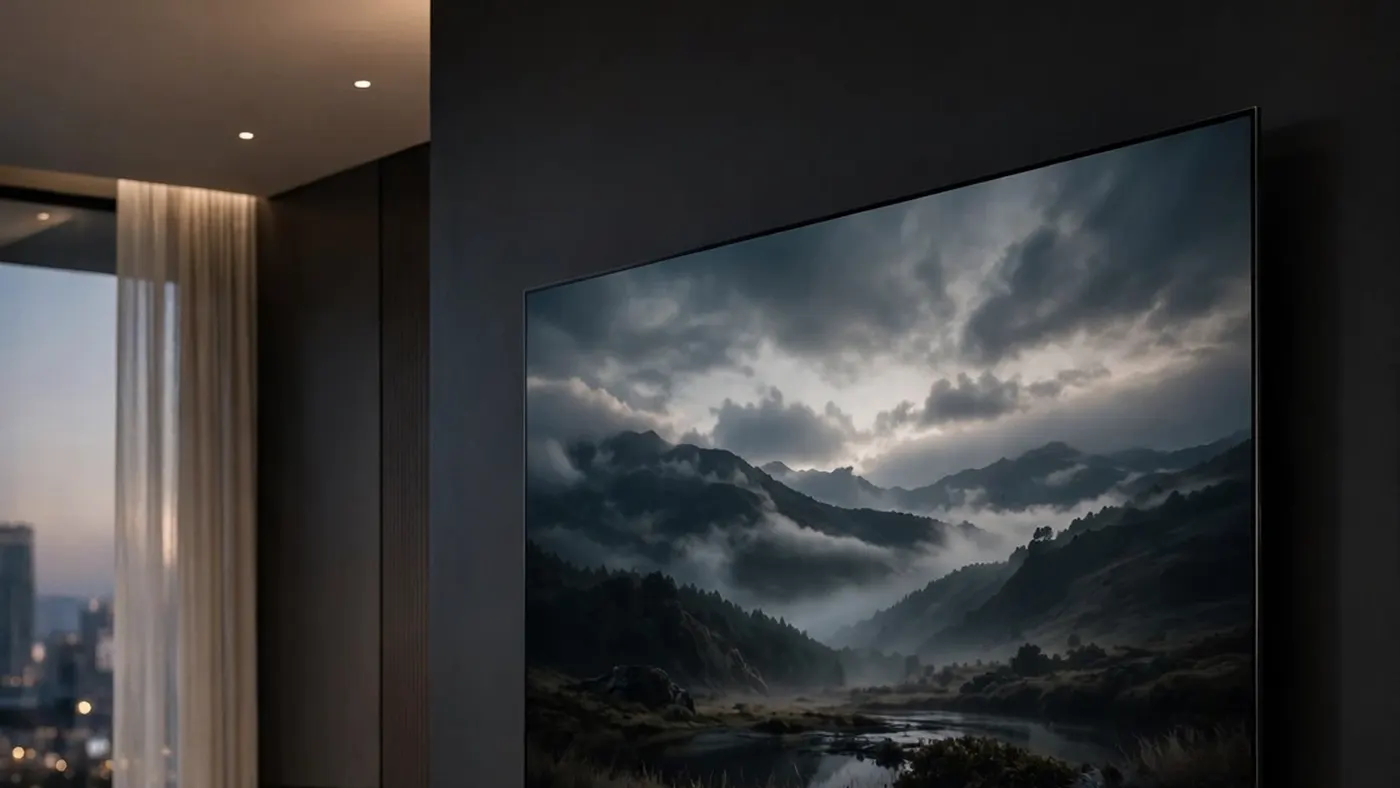
What people are actually buying
The picture-on-the-wall look has a very specific appeal, and it has almost nothing to do with watching television. It is about the other twenty-two hours of the day, when a large black rectangle is the most visually dominant object in the room and you would rather it were something else.
There are two routes to it. The first is a purpose-built art-mode television: a matte screen designed to scatter light roughly the way paper does, a swappable frame that clips to the edge, and a single slim cable running to a separate connection box that lives somewhere out of sight. The second is a conventional television set up to imitate the same effect, sitting tight against the wall with no visible cord and a gallery of images running when it is idle.
Both routes can work, and they ask different things of your wall. What almost never works is buying the television, hanging it on whatever bracket came in the carton, and hoping the room forgives the rest.
The illusion is made of three things
When the effect lands, people cannot usually tell you why. When it misses, they also cannot tell you why. They just say it looks like a TV. Three variables do nearly all of the work, and every one of them deserves more of your attention than the model number does.
Get all three right and a mid-range panel reads convincingly as a framed piece. Miss any single one and the best screen sold this year still reads as an appliance that somebody hung on a wall.
- How far the panel stands off the wall, because depth is what your eye reads as furniture rather than artwork.
- Whether any cable, cord or power brick is visible from a normal standing position in the room.
- How the edge of the screen meets the wall, which covers the frame, the bezel and the width of any mat.
The mount does more for the look than the television does
A framed print sits within a centimetre or two of the plaster. A television on a standard bracket typically stands off considerably further, and that gap throws a shadow line along the bottom and sides. Your eye catches that shadow instantly, even at a glance from across an open-plan room, and it reads as depth. Depth reads as object. Object reads as television.
A genuinely flush mount closes that gap. It is the single largest contributor to the effect and the part most often skipped, because the panel goes up either way and the difference only becomes obvious once you are living with it. A flush setup also comes with trade-offs worth knowing before you commit. There is no tilt and no swivel, so the height and the seating position have to be right the first time. The wall has to be genuinely flat, because sitting a rigid panel tight to a wavy or bowed surface exaggerates every ripple. And the television needs a sensible way to be serviced or removed later without damaging anything.
Whether your particular wall can carry a flush installation cleanly is a question for an installer, not a question for a product page. A good one will look at what the wall is made of, how it is built behind the surface, and where the panel needs to land, and will tell you plainly what is achievable before anything is ordered.
The cable is what gives it away
One visible cord undoes everything else. This is the most common reason a room that should have looked beautiful simply looks like a television with a nice frame around it.
Art-mode sets help by reducing the tangle to a single slim cable running to a separate box, but that cable still has to travel somewhere and terminate somewhere. Power is the harder half of the problem. A television needs it, and an outlet in the wrong place either shows or forces a compromise in where the screen can sit. Where the existing outlet is relative to where you want the picture is one of the first things worth checking, before you buy anything at all, because it can quietly decide the whole layout.
How power and signal get handled behind a wall is regulated work and it varies by building and by province. It is an installer and electrician question, and it is one we answer on site rather than in advance, because the honest answer depends on what your wall actually is. The connection box also needs a home. Decide early whether it lives in a cabinet, on a shelf, or in another room entirely, because that choice affects where your other equipment goes and how your remote behaves.
Frames, bezels and mats
Screen finish matters more than frame style. A glossy panel reflects the room back at you, and a mirror on the wall never reads as a painting. A matte screen scatters light and holds the illusion in daylight, which is exactly when people are walking past it and forming an impression.
On frames, restraint wins. A slim, simple profile in a colour that answers your trim, your floors or your furniture will disappear into the room. A heavy ornate gilt frame around a sixty-five inch panel looks like a television wearing a costume, because the proportions of a modern widescreen do not match the proportions that ornate frames were designed for. If you are working with a conventional television instead, remember that its black border is a permanent mat you did not get to choose, and that a darker artwork with its own dark edges will absorb that border far more gracefully than a bright white gallery scan will.
Mat width is a real decision too. A wide mat makes the screen look smaller and more deliberate, and no mat at all makes it look larger and more contemporary. Neither is wrong, but pick one on purpose.
Art mode is a setting, not a miracle
A framed print reflects light. A television emits it. That difference never fully goes away, and it is most obvious at night, when a bright image on the wall glows in a way that paper cannot. Most sets have brightness sensors and motion sensors intended to manage this, dimming in low light and switching off when the room empties. They are worth setting up properly, and they are the difference between a screen that feels ambient and one that feels like a lit sign.
Content choice matters more than people expect. Muted, textured, low-contrast images hold the illusion best: charcoal studies, faded botanical prints, weathered landscapes, abstract washes. High-contrast digital art with pure whites and saturated blocks announces itself as a screen from the doorway. Black and white photography tends to work beautifully. So does your own photography, printed large and desaturated slightly, which also gives the wall a reason to exist beyond decoration.
There are subscription art libraries available for most of these sets. They are pleasant, and they are also entirely optional. A small rotation of ten images you genuinely like will outperform a thousand you scroll past.
Which rooms earn it
This setup pays for itself in rooms where you look at the wall when the television is off. That is the whole test. An open-plan great room where the screen is visible from the kitchen and the front hall qualifies immediately. So does a small condo living room where one wall is most of the room. So does a dining room, a bedroom, or a home office wall that appears behind you on every video call.
It earns much less in a dedicated basement theatre where the lights are down and nobody is admiring the wall, in a playroom, or in a gym. It also earns less in a household where the television is genuinely on most of the evening, because you are paying for an off-state you rarely see.
There is a resale dimension as well. A tidy, flush, cable-free feature wall photographs well and reads as finished to a buyer walking through, where a screen standing proud of the wall with a cord dropping to a socket reads as unfinished.
What actually disappoints people
We would rather set expectations honestly than have you discover these afterwards. None of them are dealbreakers, and all of them are easier to accept when you knew they were coming.
- Nobody is fooled from two feet away, and that was never the goal; the effect is built for the glance from across a room.
- A bright room with windows opposite the screen will show reflections on any panel, and a matte screen reduces this rather than eliminating it.
- Chasing the framed-art look often pulls the screen higher than it should be, and a beautiful wall you have to look up at stops being beautiful about twenty minutes into a film.
- The tidy, cable-free wall is usually a larger part of the project than the mount itself, and it is worth budgeting for from the start rather than treating as an extra.
- Enthusiasm for rotating the artwork tends to fade after a month, so choose images you would be happy to leave up for a year.
How to decide before you spend
Start by standing where you actually stand. Walk in the front door, stop in the kitchen, sit on the sofa. Decide whether the off-state of that wall genuinely bothers you, because if it does not, a conventional mount done well will make you just as happy for a good deal less.
If it does bother you, work backwards. Confirm the wall you want is the wall that suits viewing, not just the wall that suits the picture. Check where the power currently is. Find out what your wall is made of and whether your building has rules about it. Then choose the television, because the room should be deciding the screen rather than the other way round.
When you talk to an installer, say the goal out loud: you want it to look like a picture when it is off. That single sentence changes the mount that gets specified, the way the cabling is planned, and the height that gets recommended. It is the most useful thing you can tell us, and it is the thing people most often leave out.
Art-mode above an Ottawa fireplace
The most common request we get in the west-end suburbs is an art-mode television above the fireplace on a stone or tile feature wall. It can look superb. It is also the combination most likely to produce quiet regret, and the reasons are worth understanding before you commit.
The first is height. A fireplace surround pushes the screen up, and the framed-art instinct pushes it up further, because art hangs high. Together they can put the picture well above a comfortable viewing line for a sofa eight or nine feet away. You get a wall that looks lovely and an evening that leaves your neck stiff. Where the room allows it, a lower position on an adjacent wall often gives a better result on both counts.
The second is the wall itself. Stone, manufactured stone veneer and large-format tile all behave differently from drywall, and a flush installation on that kind of surface is a different job with different constraints. Some of these walls are excellent candidates. Some are not. That determination happens on site.
The third is heat and tidiness. A working fireplace below a screen changes what is sensible, and a stone surround changes where power and signal can reasonably be handled. In Ottawa there is a fourth factor as well: many of these homes have a finished basement rec room that gets the real television use in January. If that is your household, the art-mode set belongs upstairs where it is seen, and the basement wants a straightforward, well-positioned mount instead.
What this costs in Ottawa
Flat pricing by screen size, taxes and the wall mount quoted before you book. No hourly rate, no surprise line items on the day.
Your exact total, tax included, takes about a minute on the price tool. A $25 deposit holds the slot and comes off the final bill.
Questions we get asked
Do I have to buy an art-mode television to get this look?
No. A conventional television sat genuinely flush with no visible cable gets you most of the way there, and it can be an excellent result. What a purpose-built art-mode set adds is the matte screen finish, the swappable physical frame and the single-cable arrangement, which together make the illusion hold up in daylight and at closer range.
Will it look like art when the television is on?
No, and it should not. When it is on it is a television and it should be a good one. The framing and the flush fit are for the hours it is off, which for most households is the large majority of the time.
Does a flush mount work on every wall?
No. Flush mounting asks more of a wall than a standard bracket does, and some walls, wall constructions and building rules will not allow it. This is one of the few things that genuinely has to be assessed in person, and we would rather tell you before you buy the television than after.
Does running the picture all day cost much or wear the screen out?
Modern sets run art mode at a fraction of normal brightness and use light and motion sensors to dim or shut off when the room is dark or empty. Configured properly it is a modest draw. Configured badly, with the sensors disabled and brightness pinned high, it is neither efficient nor convincing.
Can the frame be changed later?
On purpose-built art-mode sets, yes, the frames are designed to be swapped and it is a straightforward change. On a conventional television there is no physical frame to swap, so the equivalent decision is made once at installation and is not something you would revisit casually.
What is the single most common mistake with these setups?
Spending on the television and economising on the wall. The panel is the part people compare online, but the mount, the flatness of the wall and the absence of a visible cable are what the room actually reacts to. A modest screen on a well-prepared wall beats an expensive one on a rushed install every time.
We have a stone feature wall in Kanata. Can a television sit flush against it?
Sometimes, and it depends entirely on how the wall was built rather than on how it looks. Manufactured veneer, full stone and large tile all behave differently, and what sits behind them matters more than the surface. It is a straightforward assessment on site and we will tell you before you buy anything.
Is art mode worth it in an Ottawa basement rec room?
Usually not. Basement rooms tend to be used with the lights low and the screen on, which is precisely the situation where art mode adds nothing. Spend the effort on getting the height, the seating distance and the cabling right down there, and save the framed look for a wall people actually look at when the television is off.
Ready to get it on the wall?
Answer a few questions and you will see your exact total, taxes in, before you book anything. Book now, mounted today, not next week.